A truly bear-proof bird feeder setup comes down to three things working together: a feeder with mechanical access controls (like weight-triggered closing or locking ports), a hanging or pole system that physically blocks a bear from reaching it, and consistent habits that remove every other attractant around the area. Get all three right and even a persistent black bear will give up and move on. Miss one, and you'll be cleaning up seed and bent metal in the morning.
How to Install Bear-Proof Bird Feeders Step by Step

Marcus Brennan
18 May 2026
What makes a feeder truly bear-proof
The word 'bear-proof' gets thrown around loosely, so let's be honest about what it really means. No feeder hanging from a standard shepherd's hook 5 feet off the ground is bear-proof. A 200-pound black bear can swipe a feeder off that hook in seconds. Real bear resistance is a system, not just a product.
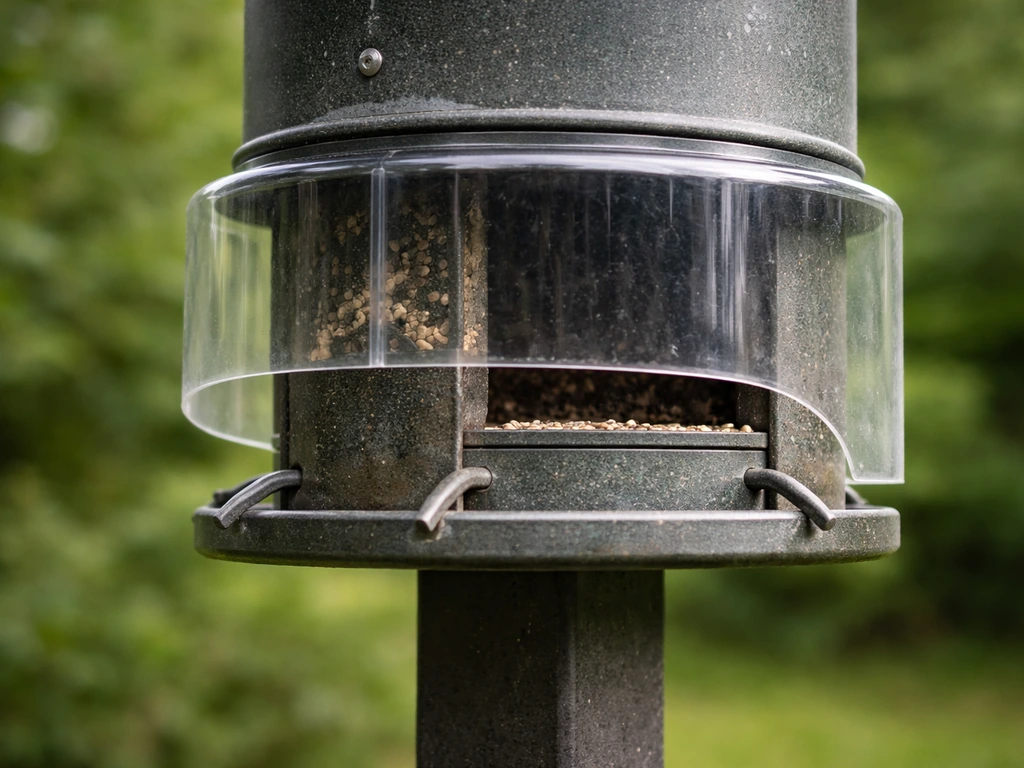
Mechanically, a bear-resistant feeder needs to do two things: deny access to seed through the ports when a bear interacts with it, and survive the physical force of a bear pulling, batting, and biting it. Weight-activated designs like the Brome Squirrel Buster series work on this principle: when an animal heavier than the target birds climbs onto the feeder, its weight forces a shroud down over the feed ports, cutting off access entirely.
Weight-activated designs like the Brome Squirrel Buster series work on this principle, and Brome explains that the animal’s weight forces a shroud down so the feed ports become inaccessible. Bears trigger this immediately.
Locking lids with twist-or-button mechanisms add another layer, preventing a bear from simply prying the top off and scooping seed directly. Sturdy construction matters too: thin plastic cracks under bear pressure, so look for heavy-gauge metal or reinforced polycarbonate bodies.
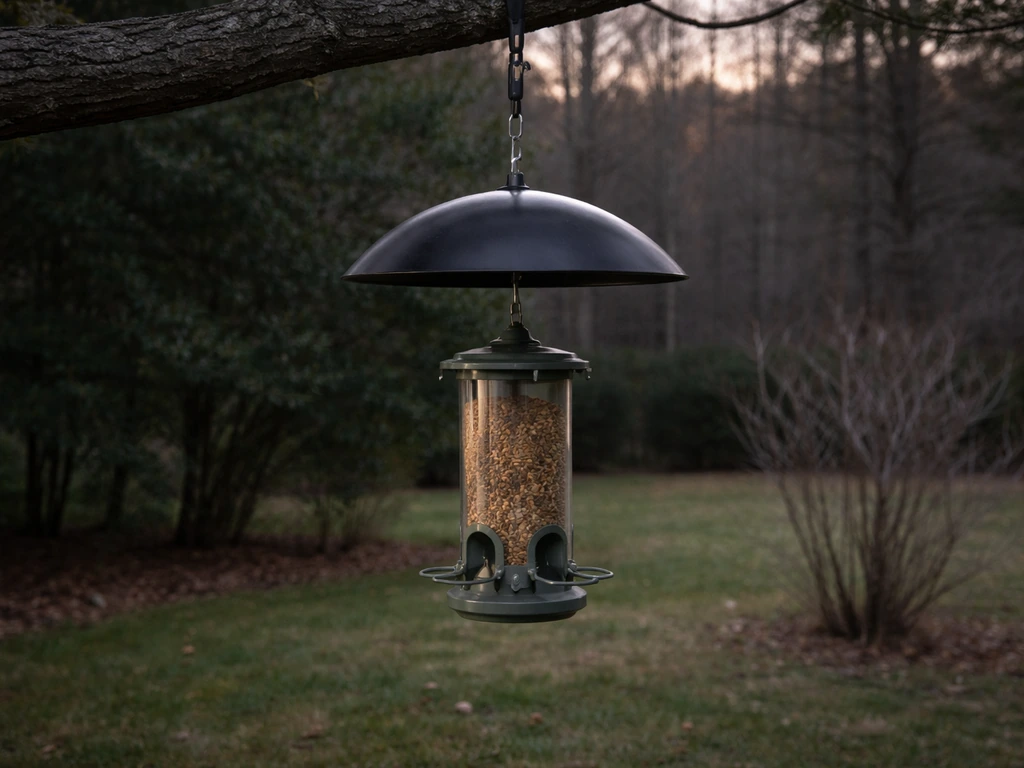
Beyond the feeder itself, 'bear-proof' in the real world means the entire mounting system resists climbing, pulling, and reaching. BearWise guidelines emphasize that the feeder arrangement as a whole needs to be secured and maintained, not just the feeder body. Think of it as a layered defense: the feeder handles direct access, and the mounting system handles the approach.
Choosing the right bear-proof feeder type and features
Not every feeder marketed as 'bear-proof' will hold up. Here's what to actually look for when you're shopping.
Features worth paying for
- Weight-activated port closure: the shroud or sleeve drops over seed ports when weight exceeds a set threshold (usually adjustable from 4 oz to several pounds). Bears activate this instantly.
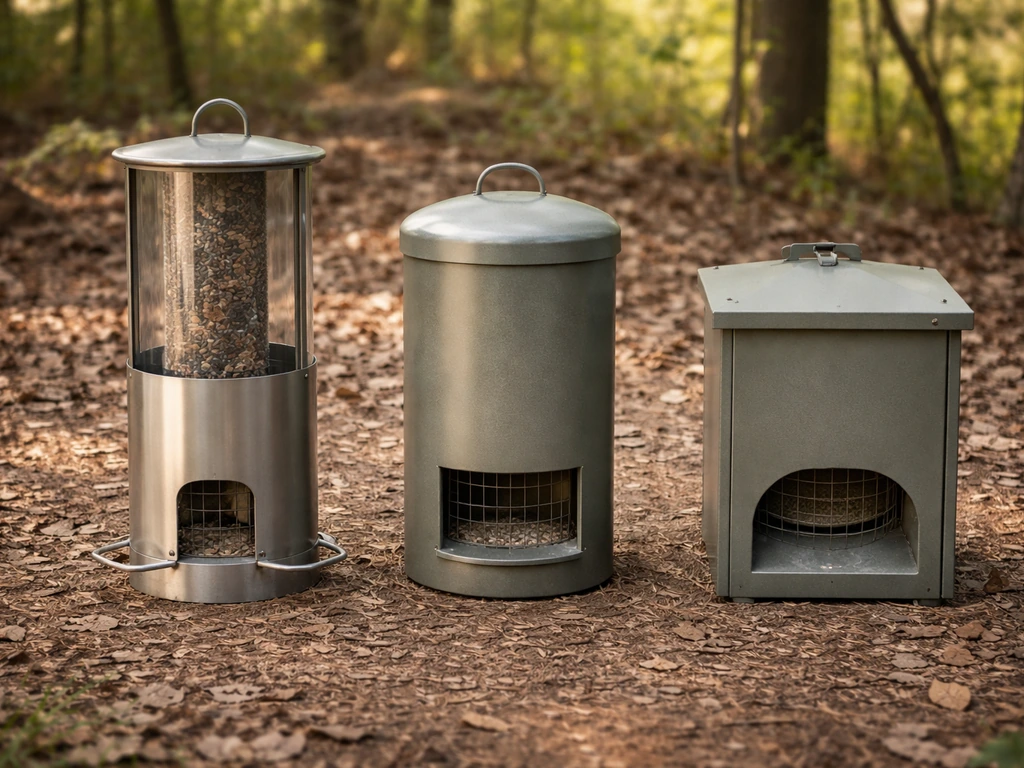
- Locking lid or reservoir: a lid that requires a twist, press-button, or tool to open stops a bear from scooping seed straight from the top.
- Heavy-gauge metal or thick polycarbonate body: thin plastic gets crushed or cracked. Metal tube feeders with steel end caps are a strong choice.
- Anti-tilt design: some feeders have a wide base or weighted bottom so a bear can't flip them to shake seed out.
- Integrated hanging loop or cable attachment point rated for high loads: cheap plastic hooks snap. Look for a metal hanging loop or a drilled hole sized for a steel cable.
Feeder types compared
| Feeder Type | Bear Resistance Level | Best For | Watch Out For |
|---|---|---|---|
| Weight-activated tube (e.g., Squirrel Buster style) | High — ports close automatically | Sunflower, safflower, mixed seed | Still needs a bear-proof mounting system |
| Locking metal hopper | Medium-high — lid resists prying | High seed volume, all-weather use | Must be hung well out of reach |
| Cage-enclosed feeder | Medium — cage limits direct beak access but not a determined bear | Finches, small birds | A bear can crush a lightweight cage |
| Standard tube or platform feeder | Low — no bear-resistant features | General bird feeding | Not suitable in bear country without major mounting upgrades |
My recommendation: go with a weight-activated tube feeder (heavy-gauge metal body) as your primary feeder in bear territory. Pair it with the mounting system described below and you have a solid, maintainable setup. If you're wondering how to buy a bird feeder for bear territory, use this mounting approach alongside a weight-activated tube feeder.
Best placement and setup: distance, height, and access paths
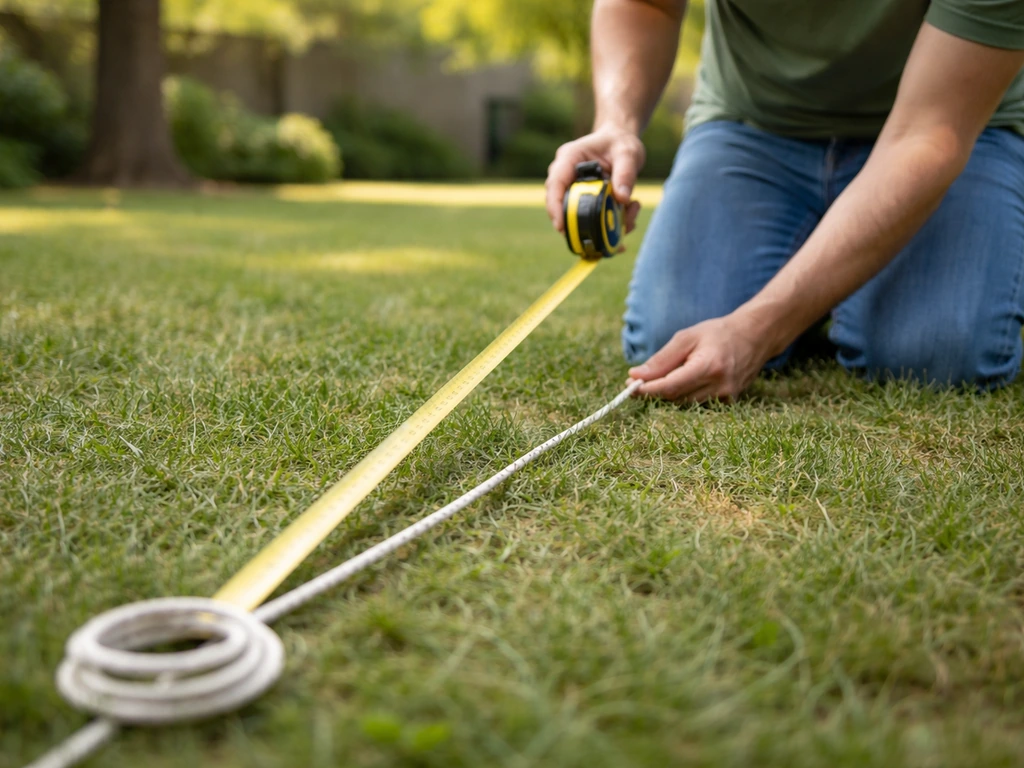
Placement is where most people fail first. If you are also wondering how to start a bird feeder, begin by choosing placement and height before you buy any parts. Even a great feeder in the wrong spot is an easy meal for a bear. Here are the numbers that matter.
Distances from structures and trees
- At least 10 feet horizontally from any tree trunk, branch, roofline, fence, or deck railing. Bears are excellent climbers and will use anything nearby to reach across.
- At least 10 feet away from your house or outbuildings. This also reduces the chance of a bear associating your home with food.
- Keep the feeder visible from inside your home if possible, so you can monitor it without going outside.
Height requirements
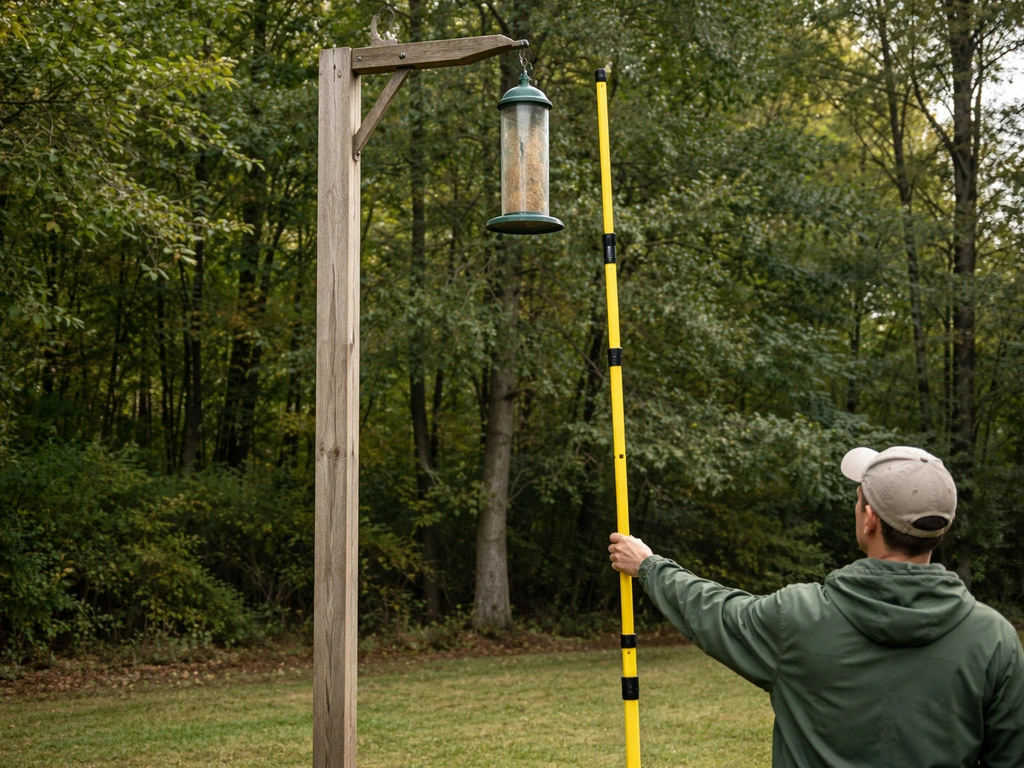
The bottom of the feeder should hang at least 10 feet off the ground. A standing black bear can reach 7 to 8 feet with a swipe, so 10 feet gives you a real buffer. If you're using a pole system, the top of the pole needs to be at least 10 feet high with a baffle mounted at the 5 to 6 foot mark on the pole to stop climbing.
Thinking about bear access paths
Walk around your chosen spot and look at it like a bear would. Is there a fence post 8 feet away that a bear could use as a launch point? A low-hanging branch overhead? A compost bin or grill nearby that gives a bear a reason to be in that part of the yard anyway? Relocate the feeder until you find a spot that's genuinely isolated, not just sort of far from things. This step takes 10 minutes and saves a lot of frustration later.
Hanging methods that prevent bear access
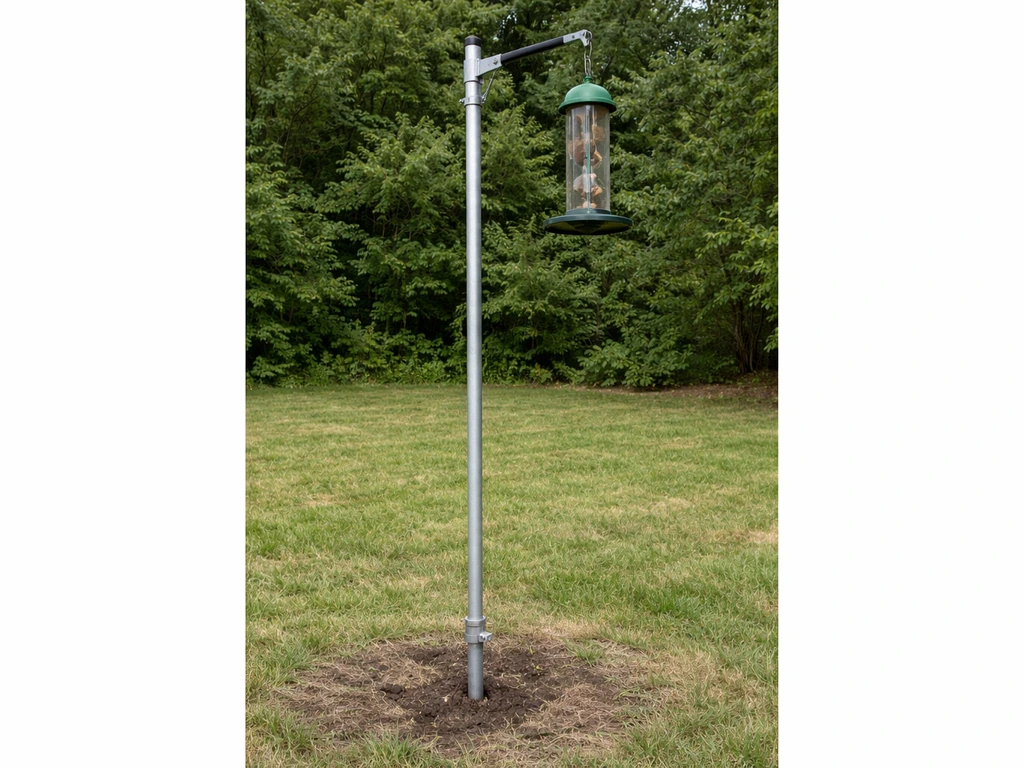
How you mount the feeder matters as much as where. You have two main options: a freestanding pole system or a cable/wire hang system. Both work well when done right.
Pole systems
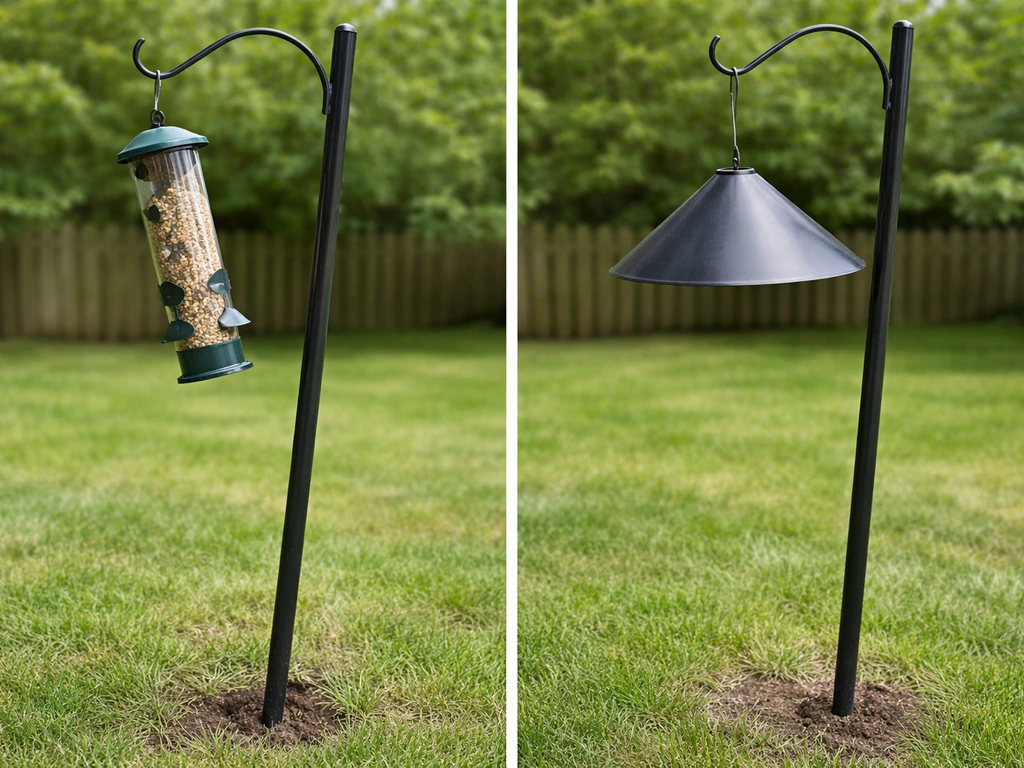
A steel pole system is the most reliable option for most backyards. Use a 1-inch or thicker steel EMT conduit or a purpose-built bird feeder pole with a ground anchor. The pole needs to be anchored at least 2 feet deep in the ground (use a ground socket or concrete for permanent setups). Mount a cone-style bear baffle on the pole at the 5-foot mark.
The baffle should be at least 24 inches in diameter, smooth on the outer surface, and angled so a bear's paws slide off rather than grip. A bear pushing up against a properly sized metal cone baffle simply cannot get purchase to climb further. Make sure the baffle sits tight against the pole with no gap a paw can squeeze through.
Cable and wire hang systems
For a cable hang, the setup is a horizontal cable strung between two anchor points (two trees or two poles) with the feeder hanging from the midpoint. The key specs: use a stainless-steel cable with at least 480 lb breaking strength (systems like the Rabbit Rail 'Bear Proof Out on a Limb' are purpose-built for this).
Rabbit Rail’s “Bear Proof Out on a Limb” cable system specifies a stainless-steel cable with a stated 480 lb breaking strength and describes the pulley and swivel-style hanging approach as part of the system Rabbit Rail “Bear Proof Out on a Limb” cable system.
The cable should run at least 10 feet high at its lowest point and at least 10 feet horizontally from any anchor tree or pole. A pulley or swivel at the center allows you to lower the feeder for filling without requiring a ladder every time. The cable itself is too thin for a bear to walk or climb, and the height and horizontal clearance keep them from reaching it from the anchor trees.
Hardware checklist before you hang anything
- Stainless-steel or galvanized cable, minimum 480 lb rated breaking strength
- Cable clamps or swage ferrules (not just a knot, which slips under load)
- Locking carabiner or swivel rated for at least 150 lb for the feeder attachment point
- Steel pole with ground socket or concrete anchor for pole setups
- Smooth metal cone baffle, minimum 24 inches diameter
- Stainless-steel lag screws or eye bolts if anchoring to trees or structures (rated for the combined load)
Adding bear deterrents safely: no attractants and cleanup routines
Even a perfect hanging system can get overwhelmed if your yard is a smorgasbord for bears in every other way. The feeder is one food source, but if bears are already in your yard for other reasons, they'll inevitably find the feeder and work harder to get it. Reduce every other attractant first.
What to avoid near the feeder area
- Suet, mealworms, and fruit-based feeds: these have strong odors that draw bears from a distance. Stick to sunflower seeds or safflower in bear country. They're still attractive to birds but much less aromatic to bears.
- Garbage cans and compost bins within 50 feet of the feeder area
- Grills, smokers, or pet food bowls left outside
- Fallen fruit from trees near the feeder location
Daily and weekly cleanup habits
Seed spillover on the ground under the feeder is a serious problem. A pile of sunflower shells and spilled millet is basically bear bait sitting at ground level, undoing all your height and baffle work. Use a no-mess seed mix (hulled sunflower chips, shelled peanuts) that birds eat cleanly without dropping husks. Rake or sweep under the feeder weekly. Consider a seed catcher tray mounted below the feeder, emptied every few days. Bring feeders inside at night during peak bear season in your region (typically spring through fall). Even a fully secured feeder is easier to protect when it's not hanging outside at 2 a.m. when bears are most active.
If a bear has already found your feeder once, take it down for at least two weeks. BearWise guidance is clear on this: a bear that has been rewarded at a location will return repeatedly. Removing the reward breaks that association before it becomes a deeply ingrained habit.
Troubleshooting: bears still getting in
If bears are still reaching your feeder after you've set things up, something in the system has a weak point. Here's how to diagnose the specific failure. If you still need a complete walkthrough, use this guide on how to fix bird feeder setups that bears keep getting into.
Common failure modes and fixes
| Symptom | Likely Cause | Fix |
|---|---|---|
| Feeder is knocked off the hook or pole | Pole not anchored deep enough, or no baffle so bear climbed the pole | Add concrete anchor, install 24-inch cone baffle at 5-foot mark |
| Feeder is on the ground but intact | Cable or hook failed under load | Replace with rated stainless cable and locking carabiner, check all cable clamps |
| Feeder is on the ground and opened/damaged | Feeder body not strong enough, or locking lid missing | Upgrade to heavy-gauge metal feeder with locking lid |
| Seed is gone but feeder is still hanging | Bear reached feeder from nearby tree or structure | Measure horizontal clearance from all anchor points, must be 10+ feet |
| Feeder intact but seed is depleted quickly | Bear is triggering weight mechanism but spillover on the ground is still rewarding it | Switch to no-mess seed, clean under feeder daily, bring feeder in at night |
| Bear returns night after night despite good setup | Other attractants in the yard, or bear has learned the pattern | Audit yard for garbage, pet food, fruit; bring feeder indoors nightly for 2 weeks |
When the baffle isn't working
A baffle that's too small, installed too low, or has a gap around the pole is as good as no baffle at all. The baffle must be smooth metal (a bear's claws won't grip it), at least 24 inches in diameter, and positioned so the bottom of the cone is at least 5 feet off the ground.
Check that there's no gap between the baffle and the pole: some baffles have a slit for installation that a determined bear can work a paw into. Seal any gap with a hose clamp or metal tape. Also check that the baffle itself can't be pushed up the pole by bear pressure from below. A simple set screw or hose clamp just below the baffle bracket keeps it locked at the right height.
When bears seem to be learning around the barrier
Bears are smart and persistent. If a bear has found a way to get past your setup once, it will try variations of that approach. Walk your setup after each bear visit and look for claw marks: they'll show you exactly where the bear was pushing or climbing. Address that specific spot. Sometimes the fix is as simple as adding a second baffle higher on the pole, or moving the cable anchor points further from the nearest tree. Don't assume your first configuration is optimal. Iterate.
Maintaining and monitoring the system over time
A bear-proof setup isn't set-and-forget. Hardware degrades, connections loosen, and conditions change. A few regular checks keep everything working.
Monthly checks
- Inspect the cable or hanging wire for fraying, kinking, or corrosion. Replace any cable that shows visible wear, no matter how minor it looks.
- Check all cable clamps and carabiner locking sleeves. They loosen over time, especially with seasonal temperature changes.
- Test the weight-activation mechanism on the feeder: apply light downward pressure on the ports and confirm the shroud drops smoothly. Clean the mechanism if it sticks.
- Re-check horizontal clearances from the feeder to nearby trees or structures. Trees grow, and a branch that was 12 feet away in spring may be 9 feet away by summer with new growth.
Seasonal considerations
Bear activity spikes in spring (when bears emerge from hibernation hungry) and in fall (when they're hyperphagia-feeding before winter). In those seasons, bring feeders in every night without exception. During low-activity winter months in your region, you can relax the nightly routine, but keep the hardware inspection schedule. If you disassemble the feeder for winter storage, inspect the body, locking mechanisms, and hanging hardware before reinstalling in spring.
If you need to service the feeder or clean inside it, follow the safe steps for how to take apart a bird feeder before you start removing parts. This is also a good time to check the feeder's condition overall, similar to how you'd assess any other backyard equipment before the busy season.
Replacing hardware before it fails
Don't wait for a cable to snap or a latch to break. Stainless-steel cable rated to 480 lb breaking strength is inexpensive enough that replacing it every two to three years is worth it even if it looks fine. Same with carabiners: the locking sleeve on a carabiner can corrode internally without showing obvious external damage. Replace them annually in a high-humidity environment. Keeping a small kit of spare cable clamps, a carabiner, and a length of cable on hand means you can fix any failure same-day rather than leaving the feeder down or vulnerable.
Once your bear-proof system is solid, the rest of your bird feeding routine stays the same: keep the feeder clean, refresh seed regularly, and enjoy watching birds without the 3 a.m. crash of a bear doing the work for you. If you're also building or customizing your feeder setup from scratch, the same principles apply whether you're hanging a store-bought tube feeder or a DIY build. If you are building a Roamwild setup from scratch, use the same approach as this guide for choosing a secure mounting system before you assemble roamwild bird feeder. The mounting system and daily habits are what make it bear-proof, not the feeder alone.
FAQ
Do I need a bear-proof feeder if I already have a high fence or it is inside a screened patio?
Possibly, but focus on the access route. If bears cannot physically reach the feeder (including through gaps under doors, screened openings, or climbing surfaces), a standard feeder may be fine. If any path allows a bear to access food, treat the feeder like an outdoor target anyway, because bears can reach through surprisingly small openings or climb structures to get height.
How far should the feeder be from anchor trees, poles, sheds, or anything a bear could “launch” from?
Use horizontal clearance, not just height. For a cable hang, keep the cable line at least 10 feet horizontally away from each anchor, and avoid placing anchors next to climbable structures. For pole mounting, also consider nearby “step-up” points like fence tops, stacked firewood, or low branches within arm’s reach of the baffle area.
What height should I use if my backyard is tight, like I cannot reach 10 feet?
If you cannot achieve the recommended bottom height and clearances, you are increasing the odds of repeated attempts. In that case, prioritize improving the mounting defense instead of compromising both height and baffle coverage. Options include switching to a properly sized pole baffle system, using a bear-resistant feeder model with stronger access denial, and moving the feeder to an actually isolated spot rather than “as high as possible.”
Can I use a shepherd’s hook if I buy a stronger feeder or a baffle?
Usually no. A shepherd’s hook is a common failure point because bears can swipe or yank the feeder off quickly, and the hook does not provide a reliable, climb-resistant mounting geometry. A steel pole with a properly fitted cone baffle, or a purpose-built cable system with correct clearance, is the safer choice.
How do I know the baffle is the right size and installed correctly?
Check three details: the baffle diameter (at least 24 inches), the bottom height (at least 5 feet off the ground), and the absence of gaps. Pay special attention to baffles with installation slits or any opening around the pole. Even a small paw-squeeze gap can become an entry point, so test the fit and seal any vulnerable edges.
If the feeder is still being raided, how can I tell whether the problem is the feeder, the baffle, or the mounting system?
Look for the bear’s pattern. Claw marks and climbing pressure near the baffle indicate a baffle fit or height issue. Fresh tugging or movement near the pole base suggests an anchoring or bracket problem. Seed gathered directly beneath the feeder points to spill and tray issues, even if the feeder ports are technically secure.
Should I switch from a pole system to a cable system if bears keep working one setup?
Sometimes, but do it strategically. A cable system changes the geometry by removing the bear’s ability to climb the mount. However, cable systems still fail if anchors are too close, the lowest point is too low, or the cable height and horizontal clearances are not met. If you switch, re-check both the anchor placement and the ability to lower the feeder for cleaning without bypassing safety.
Is seed spill control really necessary if my feeder is bear-proof?
Yes, because spill creates an “easy food” zone at ground level that undermines the entire height advantage. Use a no-mess seed mix that birds consume with minimal husk drop, sweep or rake under the feeder weekly, and consider a seed catcher tray if your feeding style leaves residue behind.
How do I handle night feeding during peak bear season if I am not home?
The most reliable approach is to bring feeders inside every night during spring through fall in high-activity regions, so access is removed completely when bears are most active. If you cannot bring the feeder in, strengthen the overall system by reducing other attractants, keeping strict ground cleanup, and ensuring hardware and clearances are at the top of their specs.
What should I do if bears have already figured out my feeder location?
Take the feeder down for at least two weeks so the bear does not keep returning to that reward site. During that window, remove or reduce other attractants nearby, and only reinstall when you can commit to consistent cleanup and proper maintenance checks.
How often should I inspect or replace hardware like cable, carabiners, or clamps?
Inspect after each bear visit, and do scheduled checks during active seasons. Replace stainless-steel cable every two to three years even if it looks fine, and replace carabiners annually in humid areas because internal corrosion may not be visible. Keep spare clamps, a locking connector, and replacement fasteners so you can repair same-day.
Can I use a lock or twist lid alone to make a feeder bear-proof?
Not reliably. Locks can help with top access, but bear resistance requires surviving physical force and preventing access when bears climb or interact with the feeder. Make sure the design includes a real access-denial mechanism (like weight-activated port closure) and that the mount prevents reaching from the sides or from climbable nearby objects.