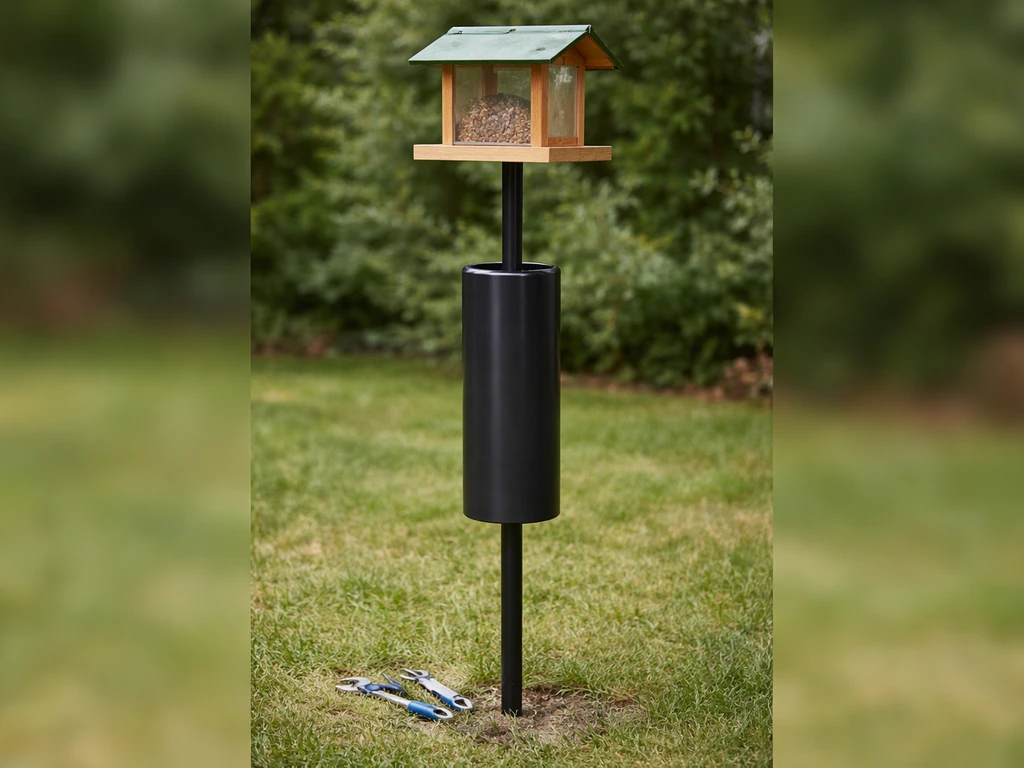
To install a baffle on a bird feeder, you either slide or clamp a cone or dome onto your feeder pole at least 4 to 4.5 feet off the ground (below the feeder), or you hang a wide disc-style baffle directly above a hanging feeder so squirrels can't shimmy down the wire. Either way, the baffle only works if your entire setup is at least 8 to 10 feet away from any tree, fence, deck railing, or other surface a squirrel can leap from. Get both of those things right and you'll block the vast majority of squirrel, chipmunk, and raccoon visits in a single afternoon.
How to Install a Baffle on a Bird Feeder Step by Step
Marcus Brennan
24 Apr 2026
Why you actually need a baffle (and what it stops)
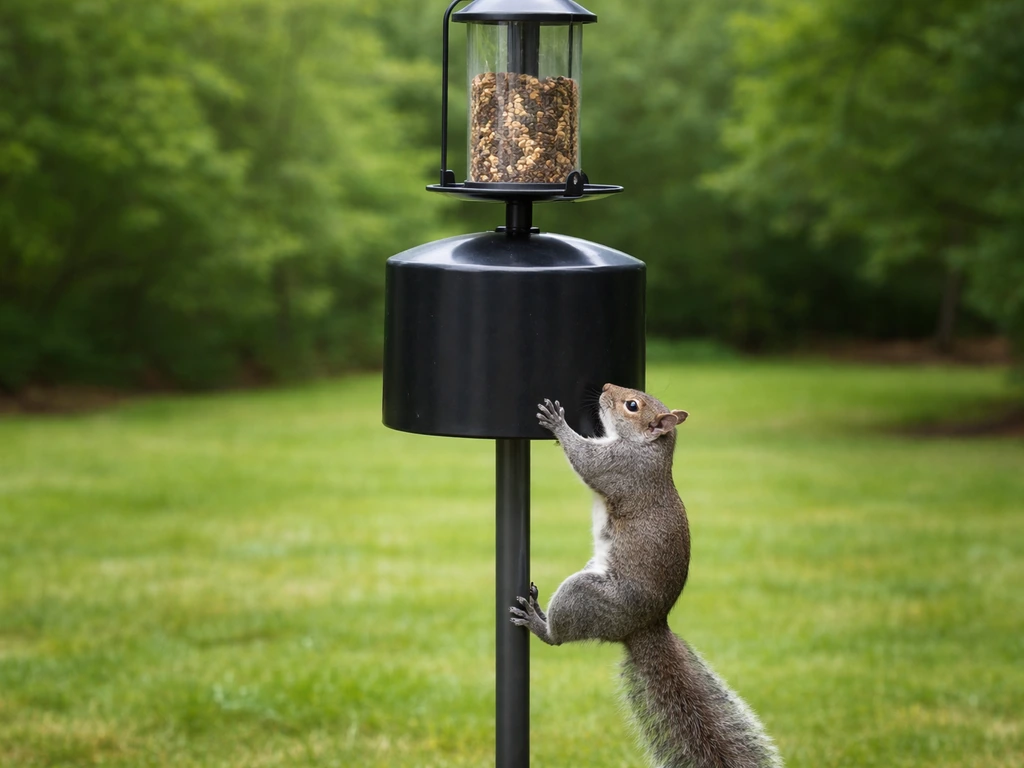
Squirrels are the obvious culprit, but a well-placed baffle also deters chipmunks, raccoons, and rats. Each pest uses a different route: squirrels and chipmunks climb straight up the pole or drop down from overhead branches; raccoons grip the pole and pull themselves up with sheer strength; rats follow wires and chains. A baffle interrupts all of those approaches by creating a physical obstacle the animal can't get past, grip around, or jump over.
Chipmunks are excellent climbers and will scale a smooth metal pole just as easily as a squirrel will. A dome or stovepipe baffle mounted on the pole creates a gap they simply can't bridge on their way up. Raccoons need a larger-diameter barrier because their long arms can reach around anything too narrow. That's why commercial raccoon baffles tend to be noticeably wider than standard squirrel baffles. Rats mostly approach hanging feeders from above, via a wire or chain, which is exactly the attack path a feeder baffle (the type you mount above the feeder) is designed to block.
The U.S. Fish and Wildlife Service notes that a feeder on a pole with a baffle is one of the least frustrating long-term pest-proofing strategies compared to trying to out-engineer individual feeders. It's a one-time setup that pays for itself quickly in saved seed.
Feeder baffle vs pole baffle: pick the right one for your setup
Before you build or buy anything, figure out which type of baffle matches how your feeder is mounted. To learn the full process step by step, follow a guide on how to assemble a standard squirrel buster bird feeder which type of baffle matches how your feeder is mounted. The two main types solve the same problem from opposite directions.
| Baffle Type | Where It Goes | Best For | Main Weakness |
|---|---|---|---|
| Feeder baffle (above-feeder disc) | Hung above a hanging feeder on the wire or chain | Hanging feeders on shepherd's hooks, tree branches, or pergola hooks | Doesn't help if squirrels can leap directly onto the feeder from a nearby surface |
| Pole baffle (cone or dome) | Clamped onto the pole below the feeder | Pole-mounted feeders on a dedicated bird feeder pole | Must be high enough off the ground and far enough from launch surfaces to be effective |
| Wrap-around stovepipe baffle | Wrapped around the pole and secured, typically below the feeder | Existing pole setups where you can't easily slide a cone over the top | Needs a snug fit to the pole diameter or pests find gaps to grip |
If your feeder hangs from a wire, go with a feeder baffle mounted above it. If your feeder sits on a pole, go with a pole baffle mounted below it. If you have a thick or decorative pole where sliding a cone over the top isn't practical, a wrap-around style is your best DIY option. When you're setting up a new feeder from scratch, a dedicated pole-and-baffle system is the cleanest solution and the easiest to get right the first time.
Materials and tools for building a DIY baffle
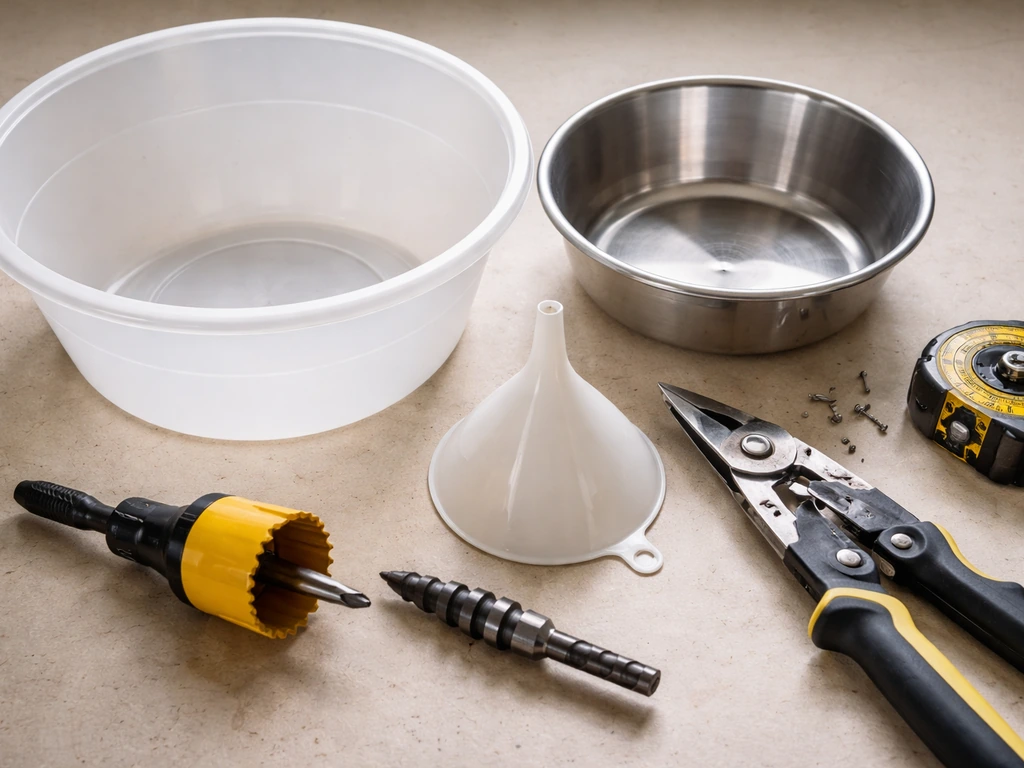
You don't need exotic materials. Most functional baffles come from hardware store basics or repurposed household items. Here's what works for each style.
For a pole baffle (cone or dome)
- A large plastic mixing bowl, a metal salad bowl, or a stovepipe cap (6 to 8 inch diameter for standard poles, larger for raccoon protection)
- A metal or plastic funnel with a hole wide enough to slide over your pole diameter (3/4 inch to 1 1/4 inch is the range most commercial pole baffles target)
- Hose clamps or U-bolts sized to your pole diameter, for securing the baffle so it can't spin down
- Waterproof sealant or a rubber grommet to protect the pole hole from moisture
- A drill with a hole saw bit sized to your pole diameter
- Sandpaper to smooth any rough edges that could catch on the pole or injure birds
For a feeder baffle (above-feeder disc)
- A large plastic plant saucer, a round plastic lid (at least 12 to 16 inches in diameter), or a sheet of corrugated plastic cut into a circle
- A center hole just large enough for your hanging wire or chain to pass through
- A metal S-hook or split ring to suspend the disc above the feeder
- Waterproof adhesive or zip ties if you want to add a downward-curving lip to the edges
For a wrap-around stovepipe baffle
- A section of 6-inch diameter stovepipe from a hardware store, cut to about 18 inches long (matching the dimensions of commercial wrap-around baffles like the Stokes Select at 18 x 18 inches)
- Sheet metal screws or a hose clamp to close the seam if your stovepipe isn't already formed into a cylinder
- A snap-on or bolt-on bracket to secure the cylinder to the pole without it spinning
How to make a bird feeder baffle (step-by-step)
These instructions cover both the cone/dome pole baffle and the above-feeder disc style. Build the one that matches your setup. If you’re wondering how to open bird feeder baffles, start by matching the baffle type to your feeder style and making sure it can’t shift or leave gaps around the pole. If you want to learn how to use a bird feeder with fewer animal intrusions, focus on choosing the right baffle style and installing it at the correct height and clearance. Either project takes about 30 to 45 minutes with basic tools.
Building a cone or dome pole baffle
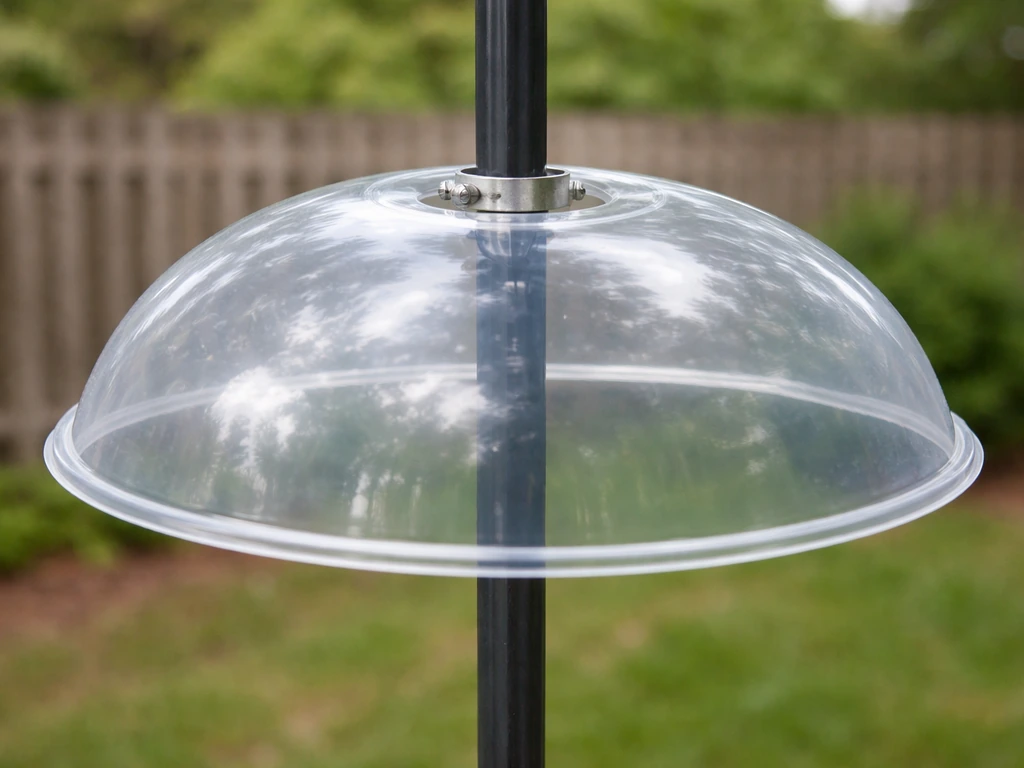
- Choose your bowl or funnel. A large plastic mixing bowl (at least 12 inches in diameter) or a metal salad bowl works well. Wider is better for stopping raccoons, since a large diameter prevents them from reaching around the edge.
- Measure your pole diameter. Most standard bird feeder poles are between 3/4 inch and 1 1/4 inch in diameter. Write that number down before you drill anything.
- Mark the center of the bowl's base. Use a marker and a ruler to find dead center, then use a hole saw or step bit to drill a hole just slightly larger than your pole diameter. You want the baffle to slide over the pole with minimal play.
- Smooth all edges with sandpaper so there are no sharp burrs around the hole.
- If your bowl is metal, apply a rubber grommet or a bead of waterproof sealant around the hole edge to prevent rust where the pole contacts the metal.
- Test-fit the bowl onto a spare section of pole to confirm it slides freely and sits level.
Building an above-feeder disc baffle
- Cut or source a disc at least 12 to 16 inches in diameter. Commercial feeder baffles like the Perky-Pet Transparent Squirrel Baffler use a 16-inch shield, and that size is a reliable benchmark for DIY builds.
- Drill or punch a small hole in the exact center, just large enough for your hanging wire or chain to pass through.
- Thread the wire or chain through the hole and secure it with a small S-hook or a split ring above the disc so the disc hangs horizontally below the attachment point and above the feeder.
- Ensure the disc hangs flat and level. If it tilts, squirrels may find a way to grip the lower edge. Add a small counterweight with a zip tie if needed.
- Optional: use a heat gun to gently curve the outer edge of a plastic disc downward by about half an inch, creating a lip that makes it even harder for an animal to grip the rim.
How to install a baffle on a bird feeder (placement and attachment)
Building the baffle is the easier half. Placement is where most people go wrong and end up frustrated when squirrels still get through. The U. S.
Fish & Wildlife Service also emphasizes bird-feeding best practices and highlights common pitfalls to avoid when trying to prevent wildlife from accessing feeders bird-feeding best practices and common pitfalls. Here's how to get it right the first time.
Once your baffle placement is correct, the next step is learning how to set up a bird feeder so the feeder stays safe and accessible. If you follow these placement and attachment tips, you’ll know exactly how to set up bird feeder baffles so squirrels and other pests are blocked from reaching the seed install a bird feeder baffle.
If you want the full end-to-end approach, see how to install bird feeder baffle for exact placement and attachment steps.
Installing a feeder baffle above a hanging feeder
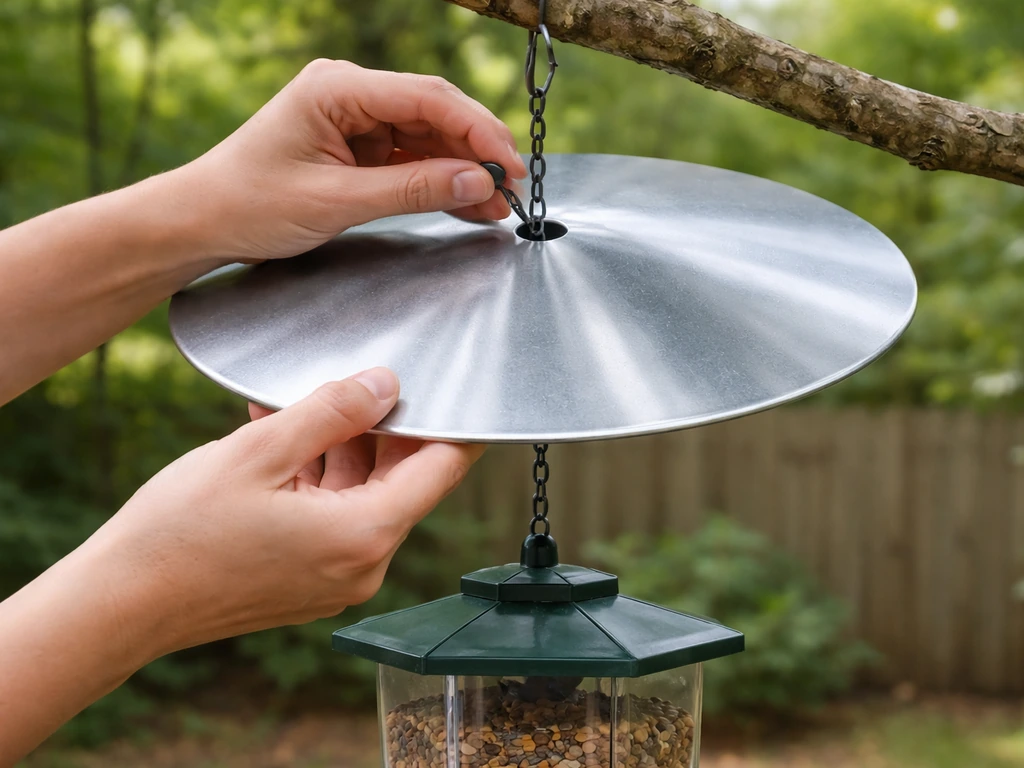
- Hang the feeder as you normally would from its hook or branch attachment point.
- Thread the hanging wire or chain up through the center hole of your baffle disc.
- Position the disc directly above the feeder, about 12 inches above the feeder's top. Perky-Pet's own guidance targets roughly a foot below the wire attachment point, which places the disc in the path of any squirrel descending from above.
- Secure the disc in place with a split ring or S-hook so it can't slide down and rest on top of the feeder.
- Check that the disc extends well beyond the outer edges of the feeder on all sides. If the feeder is wider than the disc, a squirrel can bypass the disc by dropping directly onto the feeder's roof.
Installing a pole baffle below a pole-mounted feeder
- Before you attach the baffle, confirm your feeder pole is at least 8 to 10 feet from any tree trunk, fence, wall, deck railing, or other surface a squirrel can jump from. Audubon, Wild Birds Unlimited, and most field experts agree on this clearance, and it's the single most common reason baffles fail.
- Slide the baffle onto the pole from the top before attaching any feeder hardware. If your feeder is already mounted and you can't disassemble the top, use a wrap-around style instead (see the next section).
- Position the baffle so its top edge sits at least 4 to 4.5 feet above the ground. The Wood Thrush Shop and All Seasons Wild Bird Store both cite 4 to 4.5 feet as the reliable minimum. Going lower gives a squirrel a running leap to clear the baffle from below.
- Secure the baffle to the pole using hose clamps, a set screw, or a bolt through the side of the dome. The baffle must not be able to rotate down the pole when a squirrel pushes against it from below. Test this by pushing up firmly on the baffle edge. It should not move.
- Make sure the feeder hangs or sits above the baffle with some clearance, not resting directly on it. A squirrel that can grip both the feeder bottom and the baffle top at the same time has a path forward.
How to make and install a bird feeder pole baffle (wrap-around and stovepipe styles)
A wrap-around or stovepipe pole baffle is the right choice when your pole is already fully assembled and you don't want to take everything apart to slide a cone over the top. Commercial examples like the Stokes Select wrap-around baffle are built around an 18-inch tube design specifically so you can install them without disassembling your setup.
Building a stovepipe baffle from scratch
- Buy a section of 6-inch diameter galvanized stovepipe from a hardware store. Cut it to about 18 inches long with tin snips or a pipe cutter.
- On one end, use tin snips to make a series of 1-inch cuts around the circumference, spaced about 2 inches apart. Fold these tabs outward to form a flared lip. This flared end faces down and makes it harder for an animal to grip the bottom opening.
- Measure your pole diameter and drill two small pilot holes on opposite sides of the pipe, sized to accept your bolt or set screw hardware.
- Open the seam of the stovepipe slightly (stovepipe typically comes with a snap-together or slip seam), slide it around the pole at your chosen height (4 to 4.5 feet from the ground), then close and secure the seam with sheet metal screws.
- Thread your bolts or tighten your set screws through the pilot holes so the pipe grips the pole firmly and cannot slide down.
- Give the installed pipe a firm upward push to confirm it holds. If it rotates or slips, add a second hose clamp just below the pipe as a stop.
Special mounting considerations for pole baffles
Pole diameter matters more than most people expect. Commercial pole baffles typically specify a pole diameter range, like 1/2 inch to 1 3/8 inch for snap-on styles or 3/4 inch to 1 1/4 inch for hub-style mounts. For a DIY stovepipe, the inside diameter of the pipe just needs to be larger than your pole so the pipe can sit around it, with the hardware doing the actual gripping. If there's too much gap between pipe and pole, an ambitious squirrel can get a leg inside the gap and find purchase. Wrap the pole at the mounting point with a layer of rubber tape to take up excess space if needed.
Birdseed and Binoculars describes the correct behavior well: a squirrel climbs the thin lower pole easily, reaches the baffle's interior face, and then simply can't figure out how to get past it. That only happens if the baffle is large enough that the squirrel can't reach around the outer edge from the pole, and if it's mounted high enough that the squirrel can't jump above it from the ground.
Troubleshooting and keeping things working after installation
Even a well-built baffle can fail if it's installed slightly wrong or shifts over time. Here are the most common problems and how to fix them.
Squirrels are still getting to the feeder
The first thing to check is your clearance from jump-off surfaces. Measure the actual distance from your pole to the nearest tree trunk, fence, or structure. Squirrels can leap roughly 8 feet horizontally and can drop from above. If anything is within 10 feet, they're probably bypassing the baffle entirely by jumping, not climbing. Move the pole or remove the nearby structure if possible.
Next, check baffle height. Even a few inches too low can give a squirrel enough runway to jump upward and clear the baffle from below. The 4 to 4.5 foot minimum is a floor, not a suggestion. If your pole is in a raised bed or on a deck, measure from the surface the squirrel is actually launching from, not necessarily ground level.
The baffle is slipping or rotating on the pole
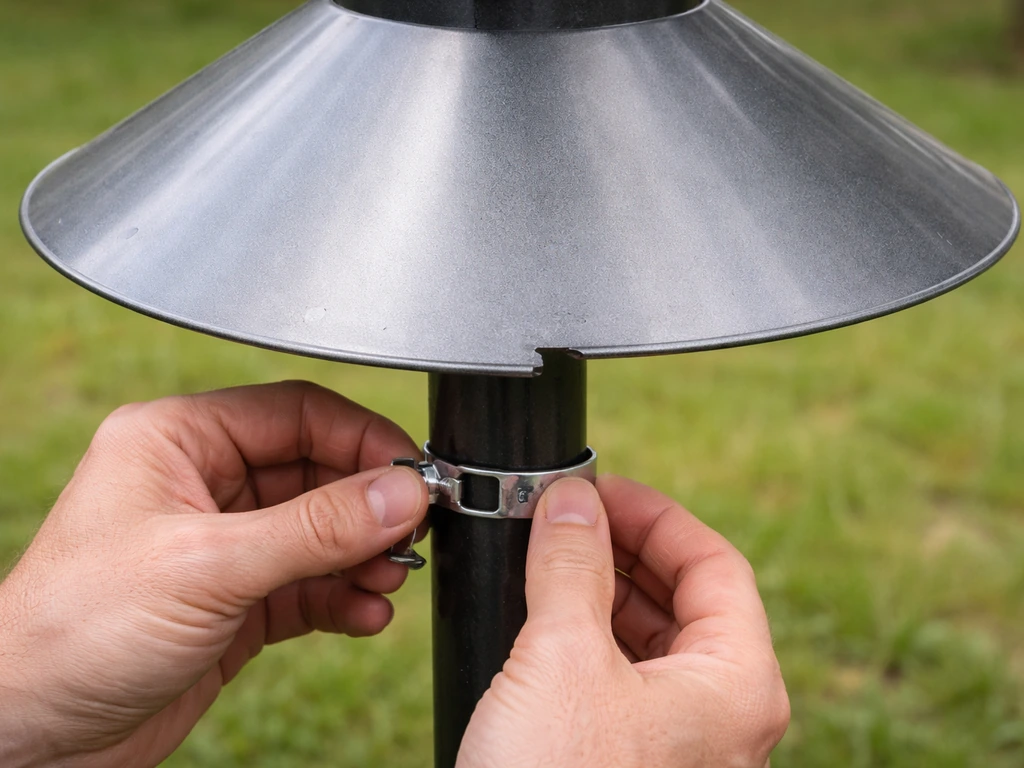
This is the most common mechanical failure. A baffle that can spin down the pole gives a persistent squirrel an inch of progress every visit until it's low enough to bypass. Add a second hose clamp directly below the baffle as a hard stop. For bolt-through designs, check that the bolts are snug and haven't worked loose from vibration. Apply a small dab of thread-locking compound if the bolts keep backing out.
The baffle isn't wide enough
If you can see a squirrel gripping the outer rim of your baffle with its front paws while hanging from the pole with its back claws, the baffle diameter is too small. Upgrade to a wider disc or cone. For hanging feeders, Perky-Pet's 16-inch commercial baffle is a reasonable minimum; for raccoons, go wider since their arm reach is significantly longer than a squirrel's. Perky-Pet positions its metal pole squirrel baffler as a baffle that stops squirrels from climbing up the feeder pole Perky-Pet's 16-inch commercial baffle is a reasonable minimum.
Gaps between the baffle and the pole
Any visible gap between the baffle's center hole and the pole is an invitation. Small animals can thread a paw or snout into a gap and use it for leverage. Wrap the pole with rubber tape at the mounting point to fill the gap, or use a grommet sized to match the pole diameter exactly.
Regular maintenance checks
Check your baffle every few weeks, especially after storms. Wind and rain can shift a baffle's position, loosen hardware, and cause plastic to warp or crack over time. Homes and Gardens explicitly recommends regular post-installation checks because shifted baffles are one of the most common reasons a previously effective setup suddenly starts failing. A five-minute inspection after each significant storm takes almost no time and saves a lot of seed.
Testing your installation
Once everything is in place, do a manual test before you declare victory. Push upward on the baffle from below with your hand and apply sideways pressure. Neither motion should move the baffle more than a millimeter or two. Then observe your feeder for the first day or two after installation. If squirrels are still visiting, watch exactly how they're getting there: climbing the pole, jumping from a nearby surface, or dropping from above. Each approach has a specific fix, and knowing which one is happening saves you from adjusting the wrong thing.
Once your baffle is solid, it's worth thinking about the rest of your feeder setup in the same systematic way. How the feeder is hung, how it's mounted to the pole, and how the whole system is assembled all affect whether your baffle can do its job. If you're building or refining your setup from the ground up, getting the hanging method and overall feeder assembly dialed in first makes the baffle installation cleaner and more effective.
FAQ
What should I do if my pole is wider than the baffle’s listed diameter range?
Use the baffle style that matches your pole, not the one you already have. For example, if a snap-on model’s spec doesn’t fit, a wrap-around or stovepipe-style baffle is usually easier because you can choose an inside diameter that clears the pole and then rely on proper clamping. If you must use a tight fit, add only thin, compressible shims to eliminate gaps, not to “force” an oversized pole into a too-small mount.
How far above the feeder should a disc-style (above-feeder) baffle be installed?
Aim to mount it so the bottom edge creates no “runway” from where squirrels can climb or jump. A practical approach is to set the disc high enough that a squirrel cannot reach its outer edge while standing on any nearby launch point. If you are uncertain, install it slightly higher than minimum comfort and then do the hand push and first-day observation test to confirm no bypass attempt occurs.
Can I install a baffle on a feeder mounted near a roof overhang or eaves?
Yes, but you must treat eaves as a jump-off surface, the same way you treat trees and fences. Measure clearance from the highest reachable edge of the overhang down to the baffle area, because squirrels can launch and also drop from above. If anything sits within about 10 feet, relocating the feeder, extending the baffle upward, or choosing a different mounting location is often more reliable than trying to “seal” the bypass route.
Do baffles also stop birds from feeding, and how can I minimize interference?
A properly sized baffle should not block birds that approach from the air, since they typically land on the feeder itself rather than climb the pole. To minimize bird disruption, keep the feeder level and accessible, avoid mounting the feeder so the baffle’s rim obstructs the perch area, and use a baffle diameter that blocks animals trying to reach the outer edge of the cone or disc.
Will a baffle work if my feeder is on a shepherd’s hook or decorative post instead of a standard pole?
Often, but the key is whether the baffle can fully grip the actual post material without leaving a gap. Smooth metal poles sometimes accept snap-on styles well, while irregular or decorative posts usually call for a wrap-around design plus rubber tape or a correctly sized grommet at the mounting point to prevent threading of paws or snouts.
How do I stop a baffle from slowly sliding down over time?
Use a positive hard stop in addition to the main mounting method. A second clamp directly below the baffle helps, and if your mount uses bolts, check snugness after vibration-prone events. In windy locations, re-check after storms and consider tightening immediately after installation once the materials settle.
What’s the fastest way to figure out how squirrels are bypassing my baffle?
Watch their exact route during the first day or two after installation. If you see them climbing, the likely issue is pole-to-baffle gap or too-small diameter. If you see them jump from a nearby surface and clear the baffle, the likely issue is insufficient clearance or a height mismatch. If you see them dropping from above, treat overhead lines or branches as part of the problem and adjust the feeder location.
Is rubber tape actually enough to seal gaps between the baffle and the pole?
It can be, if the tape fills the entire mounting interface and stays snug under weather exposure. Apply it only at the mounting point where the baffle sits, and inspect periodically because tape can dry out or shift. If you still see any visible gap or feel a looseness when you push sideways, switch to a properly sized grommet or a different baffle model that matches your pole diameter more precisely.
How often should I inspect the baffle after I install it?
Do a quick manual check weekly for the first month, then every few weeks once it’s stable. Always re-check right after significant storms, since wind and rain can loosen hardware, warp plastic parts, or cause the baffle to rotate even if it seems secure at a glance.
What baffle size should I choose if I’m trying to deter both squirrels and raccoons?
Prioritize raccoon-proofing because they can reach around narrower barriers. In practice, that means selecting a wider disc or larger cone than you would for squirrels, and ensuring the baffle is firmly anchored with no center-hole gaps. If your space limits you to a small baffle, you may get partial control for squirrels but raccoons are more likely to bypass.