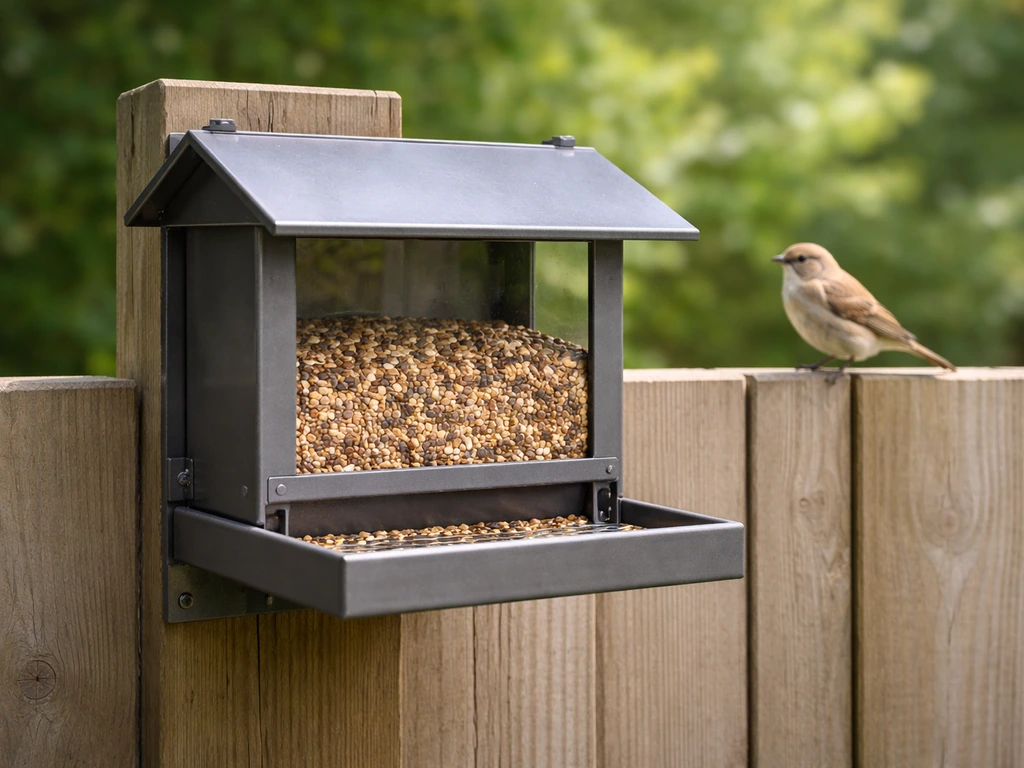
The best thing to put in a wire bird feeder depends on the mesh size and feeder style, but for most standard wire mesh feeders, black oil sunflower seeds are your go-to. They're high in fat and energy, fit cleanly through typical mesh openings without falling straight through, and attract the widest range of backyard birds. Peanuts (in-shell or shelled) work brilliantly in wire cage feeders specifically designed for them. If you want to build one yourself, focus on sturdy wire cage construction and choose the right mesh size for the food you plan to use wire cage feeders. Suet cakes are perfect for wire suet cage feeders. Nyjer (thistle) seed belongs in fine-mesh sock or tube feeders with tiny ports. The key is matching the food to the mesh opening so seed stays put long enough for birds to actually eat it. If you’re wondering what to put in a mesh bird feeder, match the food size to the mesh openings so it stays in place long enough for birds to eat it.
What to Put in a Wire Bird Feeder: Best Foods
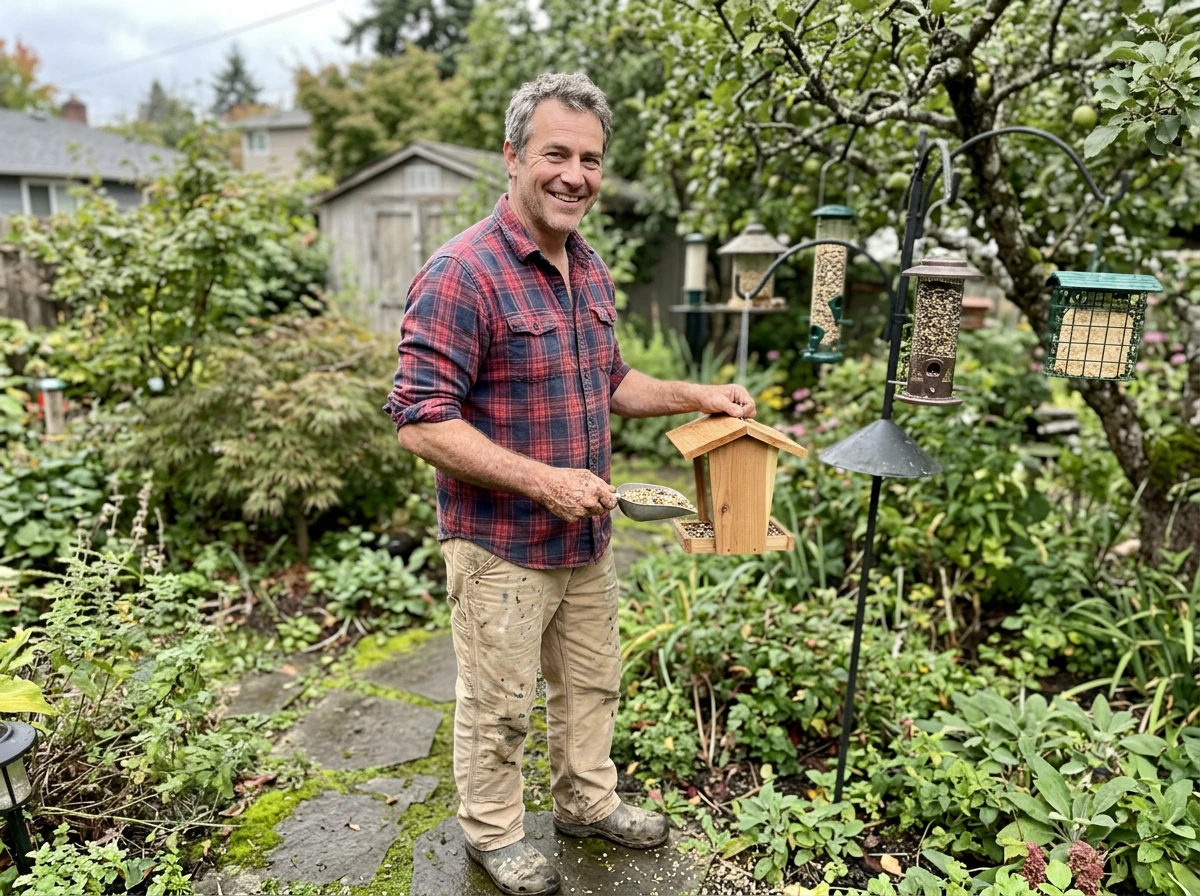
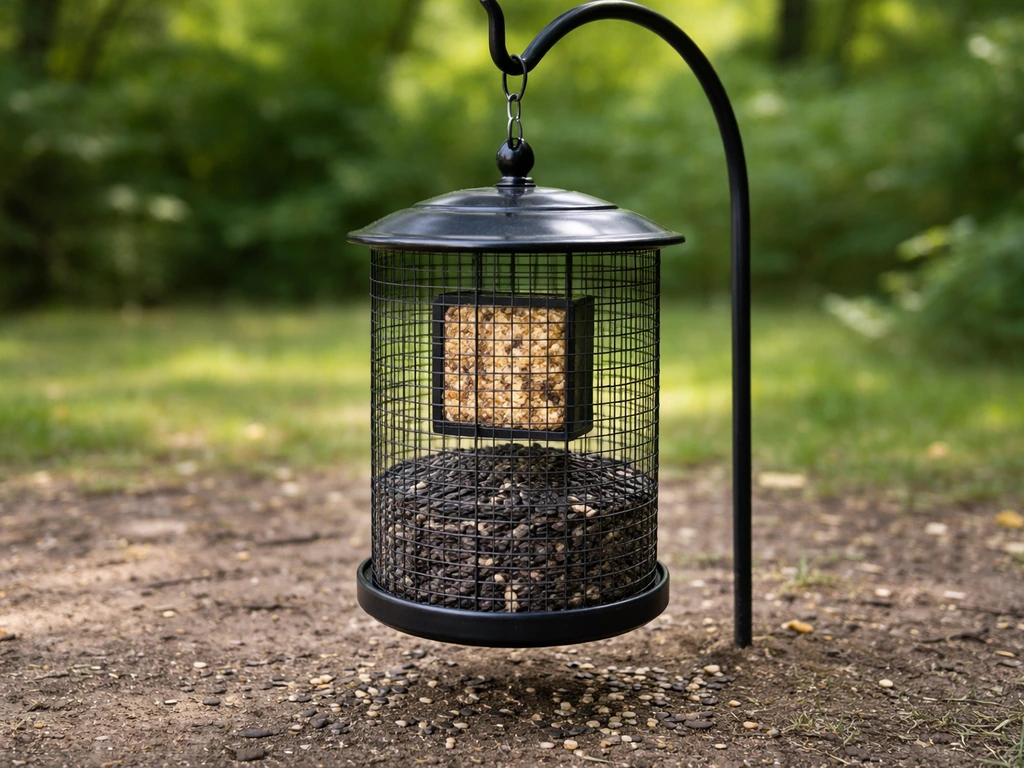
What goes in a wire bird feeder (the basics)
Wire feeders come in a few different forms, and the form matters a lot. A wide-opening wire cage or basket feeder holds peanuts, large seed mixes, and suet cakes. A tighter wire mesh feeder with smaller openings works for sunflower seeds or shelled peanut pieces. Very fine mesh socks or bags are what you need for nyjer seed, because the holes are tiny enough to hold those small seeds in place. If you put nyjer in a wide-mesh cage, it just rains out the bottom and you've wasted a bag of expensive seed.
In practical terms, here's the short list of foods that genuinely work in wire feeder designs: black oil sunflower seeds, shelled or whole peanuts (behind wire mesh so birds peck pieces rather than taking the whole nut), suet cakes or suet balls, and nyjer seed in fine-mesh sock feeders. Mixed seed blends can work too, but check that the seed pieces aren't small enough to pour out through the mesh openings.
Best seed and food choices by feeder style
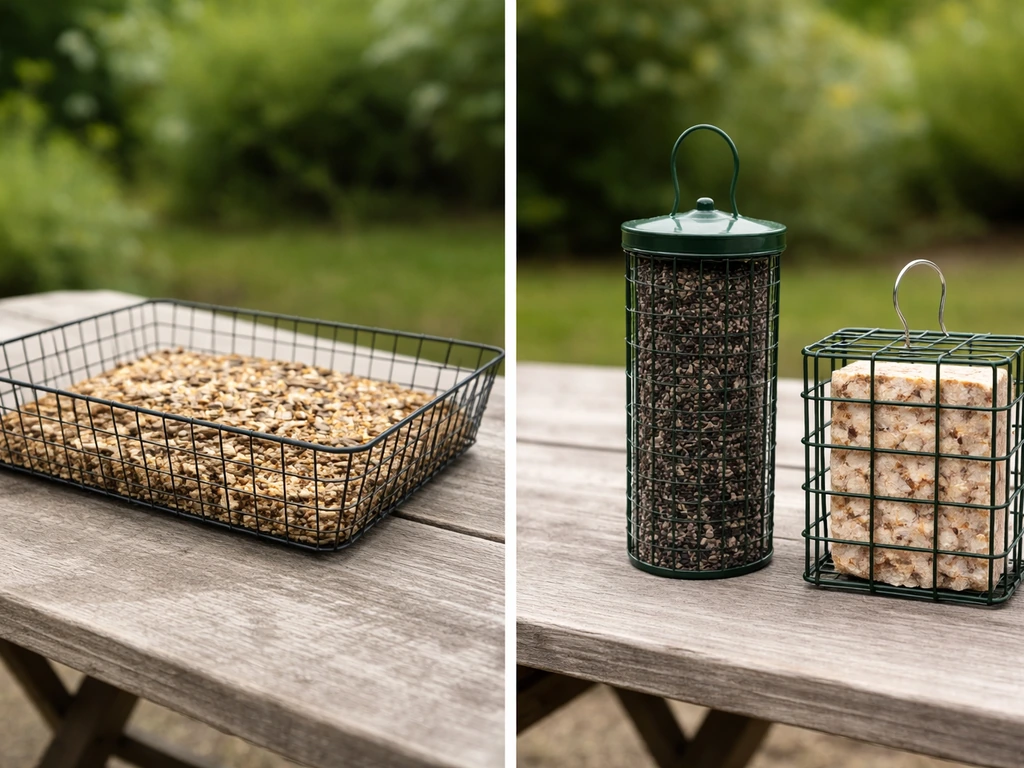
Different wire feeder designs really do call for different foods. If you're starting from scratch, this guide on how to make a metal bird feeder will help you build one that matches the right food and feeder style for your yard. Here's how to match them up so you're not wasting money or frustrating yourself.
| Wire Feeder Style | Best Food to Use | Why It Works |
|---|---|---|
| Wide wire cage or basket | Whole peanuts, large mixed seed, suet cakes | Large openings hold chunky food; birds cling and peck pieces off |
| Medium wire mesh feeder | Black oil sunflower seeds, shelled peanut pieces, safflower seeds | Mesh holds seeds in place while birds access them through the gaps |
| Fine mesh sock or bag | Nyjer (thistle) seed | Tiny holes keep small seeds contained; finches cling and extract individual seeds |
| Wire suet cage | Suet cakes, suet balls, fat-based blocks | Cage holds the cake firmly while birds chip away at it |
| Wire mesh fruit basket | Halved apples, orange slices, grapes | Open design lets fruit-eating birds land and feed without the food rolling off |
Black oil sunflower seed is the single most versatile choice if you have a medium-mesh feeder and don't want to overthink it. If you want, you can also electrify the setup by adding a safe, low-voltage heated base to help keep seed from freezing and spoiling Black oil sunflower seed. It's packed with fat and energy, the shells crack easily for smaller birds, and species from chickadees to cardinals to nuthatches go for it. Peanuts behind wire mesh are particularly smart because the mesh forces birds to break off small pieces rather than grabbing a whole peanut and flying off, which also reduces any choking or hoarding risk. Suet cakes in a wire cage are especially productive in fall and winter when birds need high-calorie food to stay warm.
How to prevent waste and keep food fresh
Wire feeders, especially mesh socks and open cage designs, are genuinely vulnerable to moisture. Rain soaks into mesh feeders fast, and wet seed clumps, ferments, and grows mold quickly. The practical fix is to fill wire feeders with smaller amounts more often, rather than loading them up and walking away for a week. This is especially true for nyjer in a mesh sock: start with a small quantity, see how fast the birds go through it, and refill based on actual demand rather than packing it full.
If your wire feeder doesn't have a built-in roof or baffle, consider hanging it under a tree branch or porch overhang that provides natural cover from rain. A dome-style squirrel baffle mounted above the feeder also doubles as a rain shield. For suet cages, choose suet cakes labeled as 'no-melt' or 'summer blend' in warm weather because standard suet softens, goes rancid, and can coat bird feathers in temperatures above about 90 degrees Fahrenheit.
- Fill mesh feeders to about half or two-thirds capacity so you're replacing seed before it sits long enough to go stale
- After rain, check the feeder and remove any clumped or darkened seed before refilling
- Store your seed supply in a sealed, dry container (a metal bin with a lid works well and keeps mice out too)
- Avoid seed mixes with lots of filler seeds like milo or oats, which birds tend to toss out, creating waste and a mess under the feeder that attracts pests
- In hot or humid weather, check suet cakes every couple of days and swap them out if they're soft or smell off
Common mistakes that lead to mess, mold, and pests
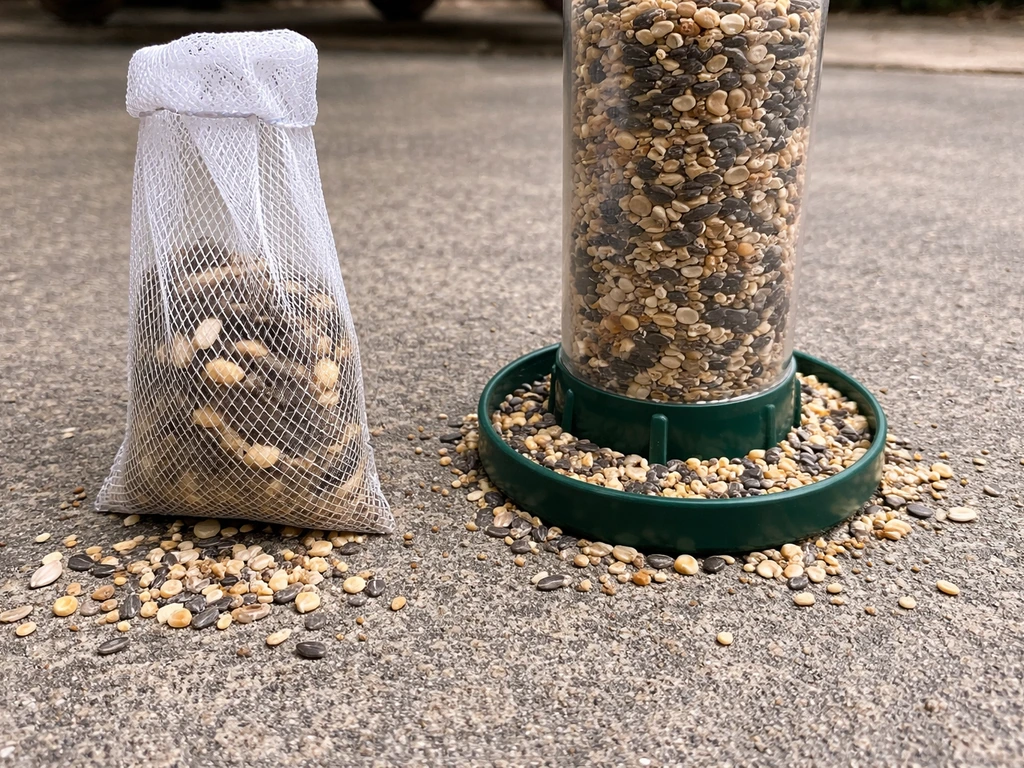
The most frequent problem I see is using the wrong food for the mesh size. Nyjer seed in a wide-mesh cage just falls straight through. Large seed chunks in a very fine-mesh sock clog the openings and birds can't extract anything. Get the pairing right first and most other problems get a lot easier to manage.
The second big mistake is overfilling. It feels generous, but a feeder packed to the brim with seed that sits through two rainstorms is just a block of moldy debris. Birds won't eat spoiled seed, and wet seed on the ground beneath the feeder draws rats and mice. Fill less, fill more often.
Squirrels raiding wire feeders are a constant headache. A wire suet cage is actually one of the more squirrel-resistant designs if it's small and designed to close under weight, but open wire baskets are an easy target. Mount a baffle on the pole below the feeder, or choose a suet cage style specifically designed to restrict access to larger animals while still letting smaller birds like nuthatches and chickadees reach the food. Starlings can also mob suet cages: an upside-down suet feeder (where birds have to cling underneath to feed) deters starlings while woodpeckers, nuthatches, and chickadees handle it fine.
Ants are another issue, particularly with anything sweet or with suet in warm weather. An ant moat filled with water, hung above the feeder on the line or hook, stops ants from crawling down to the feeder. Don't use oil or petroleum-based ant deterrents directly on the feeder pole because they can harm birds.
Which birds you'll attract and what they prefer
Wire feeders, especially ones that require clinging rather than perching, naturally filter for certain bird types. Species that are comfortable clinging to a surface, including woodpeckers, nuthatches, chickadees, and titmice, take to wire feeders easily. Birds that prefer a flat perch or ground feeding, like sparrows and doves, are less likely to use a hanging wire cage, so don't be surprised if you see fewer of those species at a wire feeder specifically.
| Food in Wire Feeder | Birds Most Likely to Visit |
|---|---|
| Black oil sunflower seeds | Chickadees, nuthatches, titmice, cardinals, house finches, goldfinches |
| Whole peanuts (wire cage) | Blue jays, woodpeckers, nuthatches, chickadees, titmice |
| Suet cake (wire suet cage) | Woodpeckers, nuthatches, chickadees, titmice, starlings, jays, Carolina wrens |
| Nyjer seed (fine mesh sock) | American goldfinches, purple finches, pine siskins, common redpolls |
| Safflower seeds | Cardinals, chickadees, doves (if feeder accessible), house finches |
If attracting goldfinches is your goal, a fine-mesh nyjer sock or a tube feeder with nyjer is your best bet. If you want to bring in woodpeckers and nuthatches, a wire suet cage is hard to beat, especially in cooler months. For a broader mix of smaller songbirds, a medium wire mesh feeder loaded with black oil sunflower seeds covers the most ground.
Where to hang your wire feeder
Placement matters more than most people think, both for bird safety and for keeping the food in good shape. The most important rule is window distance: feeders placed either very close (under 3 feet) or very far (over 30 feet) from windows are safest. Project FeederWatch instructs participants to measure the shortest distance from a window to the closest feeder when the window faces bird feeders. The danger zone is roughly 15 to 30 feet away, where birds build up enough speed to seriously injure themselves on a reflection. Keeping a wire feeder closer than 3 feet to a window means a bird that does fly toward the glass can't build up enough momentum to hurt itself.
Beyond window safety, think about cover and accessibility. Hanging a wire feeder near a shrub or tree gives birds a staging spot to wait their turn and escape quickly if a predator shows up. But keep the feeder at least 10 feet from dense cover to reduce the chances of a cat ambush. For suet cages, mounting on or near a tree trunk often works well because clinging birds like woodpeckers naturally associate tree surfaces with feeding.
Moisture exposure also connects to placement. If your wire feeder hangs in a fully open spot with no natural shelter, it will get soaked in every rain. A spot with at least partial overhead cover from a tree canopy, eave, or porch roof keeps food drier and reduces how often you need to swap out wet seed. This is especially important if you're running a fine-mesh nyjer sock, which soaks through very quickly in wet weather.
Keeping your wire feeder clean so it actually keeps working
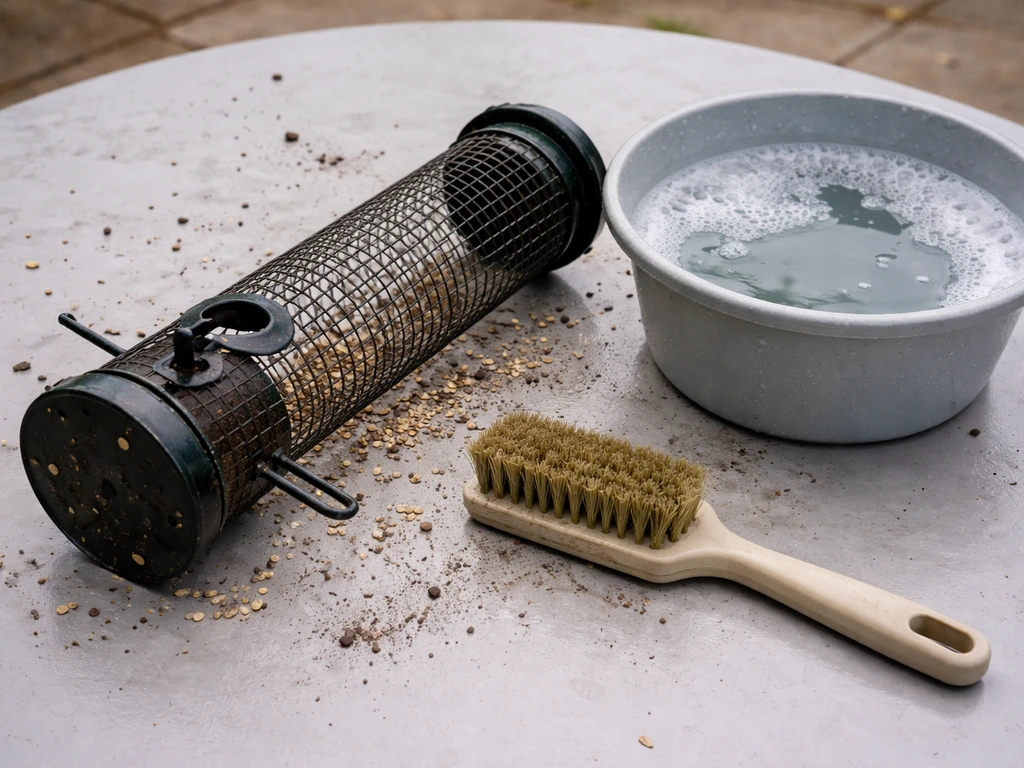
A dirty feeder spreads disease among birds and makes the food unappetizing fast. The baseline schedule is a thorough clean every one to two weeks, but tighten that up during wet weather, heavy use periods, or if you notice droppings or clumped seed building up. For winter, PA Birds advises disinfecting wire feeders by using a 1 part chlorine bleach to 9 parts water mixture, then rinsing, and continuing with weekly cleaning thereafter. Wire feeders are actually pretty easy to clean because there are no hidden corners or reservoirs where wet seed hides.
- Empty the feeder completely and shake out any debris or old seed
- Rinse with hot water to loosen stuck material
- Scrub all wire surfaces with a bottle brush or stiff scrub brush using either a dilute bleach solution (1 part bleach to 9 parts water) or a vinegar-and-water solution (4 parts vinegar to 1 part water) if mold isn't present
- Soak in the bleach solution for about 10 minutes if you're dealing with heavy buildup, droppings, or visible mold
- Rinse thoroughly, multiple times, until there's no bleach or vinegar smell left
- Let the feeder dry completely in the air before refilling, because adding seed to a damp feeder just restarts the mold problem immediately
Wire suet cages need a quick check every time you replace a suet cake. Rancid fat residue builds up on the wire and can go bad quickly in warm weather. A quick scrub with hot soapy water between cakes keeps things hygienic. Fine-mesh nyjer socks are often disposable or at least washable, and given how much they absorb moisture, replacing them seasonally or when they start to look worn is a reasonable approach.
One last thing: don't just clean the feeder and ignore the ground underneath it. Seed hulls and dropped food accumulate below wire feeders and that pile can harbor bacteria, attract rats, and grow mold that birds pick up when they forage on the ground. Rake or clear the area under the feeder every week or two, especially in wet conditions. Keeping the whole feeding station tidy is what makes the difference between a setup that works well season after season and one that becomes a problem.
FAQ
What if I put the “right” food in the wrong wire mesh size, how can I tell? (For example, nyjer or sunflower)
Check that the seed size can fit the opening without falling straight through, and make sure there is enough depth or a cage design for birds to peck at it. If you are unsure, start with black oil sunflower seed (medium-mesh feeders), because it is less likely to pour out compared with tiny seeds like nyjer.
Can I use a mixed seed blend in a wire bird feeder? What should I watch out for?
Yes, but keep the mix from being overly fine. Avoid blends that include a lot of small millet or tiny seed pieces if your feeder has smaller openings, because those fractions can sift through and leave the birds with little to eat.
How do I keep suet from going rancid or melting in summer in a wire cage feeder?
In very hot weather, use suet labeled for warm temperatures, and do not let cakes sit until they get oily or sticky. If your suet softens or appears greasy, remove it right away, rinse the cage with hot soapy water, then replace with a “no-melt” or “summer blend” option.
My seed keeps raining out. Should I change the food or the feeder?
If the food starts coming out with the first rain, the mesh is too large for that food or the feeder is not designed to retain it. Replace nyjer in a fine-mesh sock, and switch from large chunks to shelled peanut pieces behind wire mesh that is matched to the particle size.
Is it okay to top off a wire feeder when the seed gets wet, or should I empty and refill?
For most wire feeders, remove wet seed and dry-fill more often instead of topping off. A good rule is to refill in smaller amounts based on consumption, especially for nyjer socks and any feeder that gets soaked in your yard’s typical rain patterns.
Will wire feeders attract the birds I want, or am I likely to get only a certain type?
Wire feeders can bring the wrong birds if the setup encourages clinging or deters perching. If sparrows and doves are your target, you will usually have better results with a feeder that offers flat perches rather than a hanging wire cage design.
How can I reduce squirrels raiding my wire feeder beyond just adding more seed?
A common fix is a squirrel baffle above or below the feeder, or switching to a smaller suet cage that closes under weight. Also consider feeder height and mounting, because a baffle mounted too low often still allows squirrels to reach over or from a nearby branch.
What is the safest way to deal with ants on a wire feeder?
Some ants will still show up if the feeder area is sticky, especially with suet and sugary foods. Use an ant moat with water on the line or hook, and avoid oil or petroleum-based products on the pole because they can contact birds.
How often should I clean the feeder and the area underneath, and what cleaning mistakes should I avoid?
Aim for a quick, consistent cleaning that matches usage, and focus on removing old hulls and clumps below the feeder. Scrub the wire cage during cake swaps (for suet) and clear the ground under the feeder weekly or two, because dropped food can spread bacteria even when the feeder looks clean.
How to Make a Metal Bird Feeder Step by Step
Step-by-step guide to build a durable metal bird feeder with safe cutting, rustproof sealing, smart mounting and mainten