You can build a working sunflower seed bird feeder in under an hour using a wooden board and a handful of screws, or in about 15 minutes using a plastic bottle and a couple of wooden spoons. Either way, fill it with black-oil sunflower seeds, hang it on a pole at least 5 feet off the ground with a baffle underneath, and you'll have cardinals, chickadees, and nuthatches showing up within a day or two. Here's exactly how to do the whole thing, start to finish.
How to Make a Sunflower Seed Bird Feeder Step by Step
Marcus Brennan
3 Jun 2026
What you'll need before you start
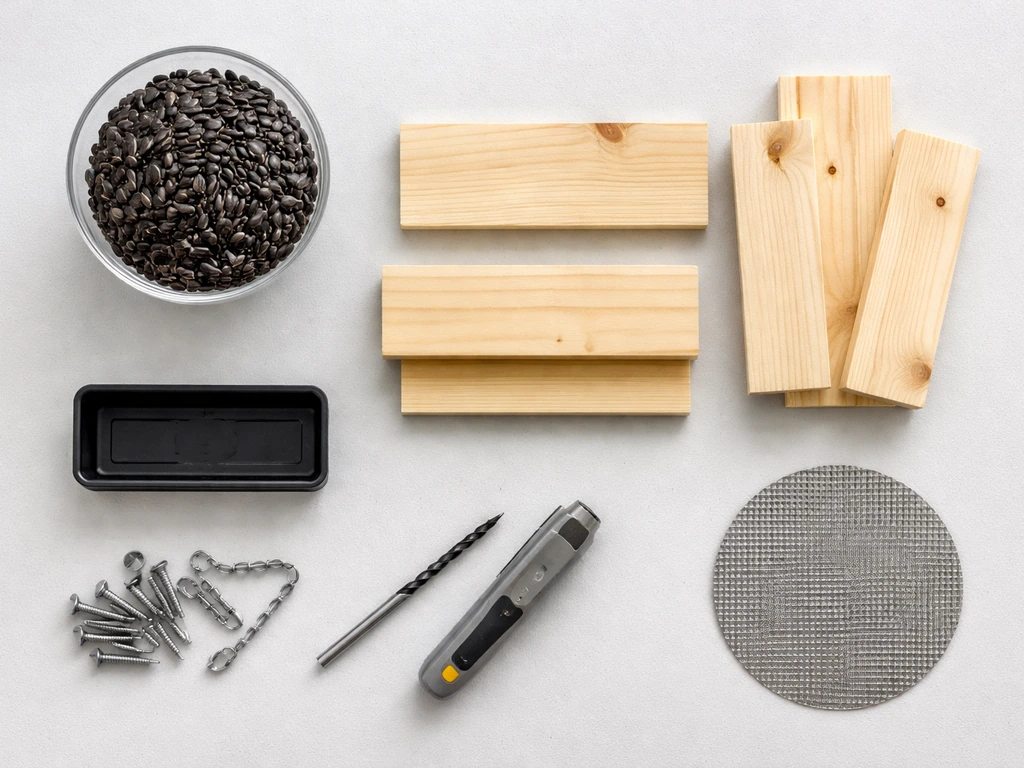
The materials depend on which build you choose (more on that below), but there's a core list that applies to almost every sunflower seed feeder. Most of these are already in your garage or cost a few dollars at a hardware store.
- Black-oil sunflower seeds (the single best choice for attracting the widest variety of birds — more on why below)
- Hanging hardware: S-hooks, eye screws, or a length of wire or paracord
- A drill with a 1/4-inch bit (for drainage holes and hanging points)
- Sandpaper (80-grit to smooth any rough edges that could snag birds)
- Exterior wood glue or waterproof wood screws if you're doing the wooden build
- A measuring tape and pencil
- Optional: mesh wire screen (1/4-inch hardware cloth) for the tray base
For the wooden hopper or tray build, you'll also want a small piece of 1x6 or 1x8 cedar or pine (roughly 2 to 3 feet long, available as a scrap cutoff at most lumber yards for under two dollars), plus four corner brackets or small L-brackets from the hardware aisle. For the bottle build, grab a clean 2-liter plastic bottle, two wooden dowels or thick wooden spoons, and a utility knife. That's really it.
Pick a feeder style that actually works with sunflower seeds
Not every feeder style is equally good for sunflower seeds, and this is worth getting right before you build. Sunflower seeds are larger than millet or nyjer, so the port size and tray depth matter a lot. The three styles you'll realistically make at home are a tray feeder, a hopper feeder, and a tube feeder.
| Feeder Style | Best For | Main Advantage | Main Drawback | DIY Difficulty |
|---|---|---|---|---|
| Tray / Platform | All sunflower seed types, large birds like cardinals and doves | Open design, easy to fill and clean, works with shelled or unshelled seeds | Seed exposed to rain and debris, needs drainage holes or screen bottom | Beginner (30 min) |
| Hopper | Mixed crowds, works especially well with black-oil sunflower | Roof keeps seed dry, holds a large reserve so you refill less often | More pieces to build, takes 45–60 min | Intermediate |
| Tube | Smaller birds like chickadees and nuthatches | Compact, easy to hang, less waste since birds pull one seed at a time | Ports must be sized right (3/8 inch minimum for sunflower seeds), harder to clean | Beginner to intermediate |
My honest recommendation for a first build is the tray feeder. It takes 30 minutes, uses the least material, and nothing about it can go wrong in a way that wastes your afternoon. If you want something that holds more seed and keeps it drier between refills, go with the hopper. The tube feeder is a good option if squirrels are already a serious problem in your yard and you want a smaller target that's easier to baffle.
Step-by-step build instructions
Build 1: Simple wooden tray feeder (recommended for beginners)
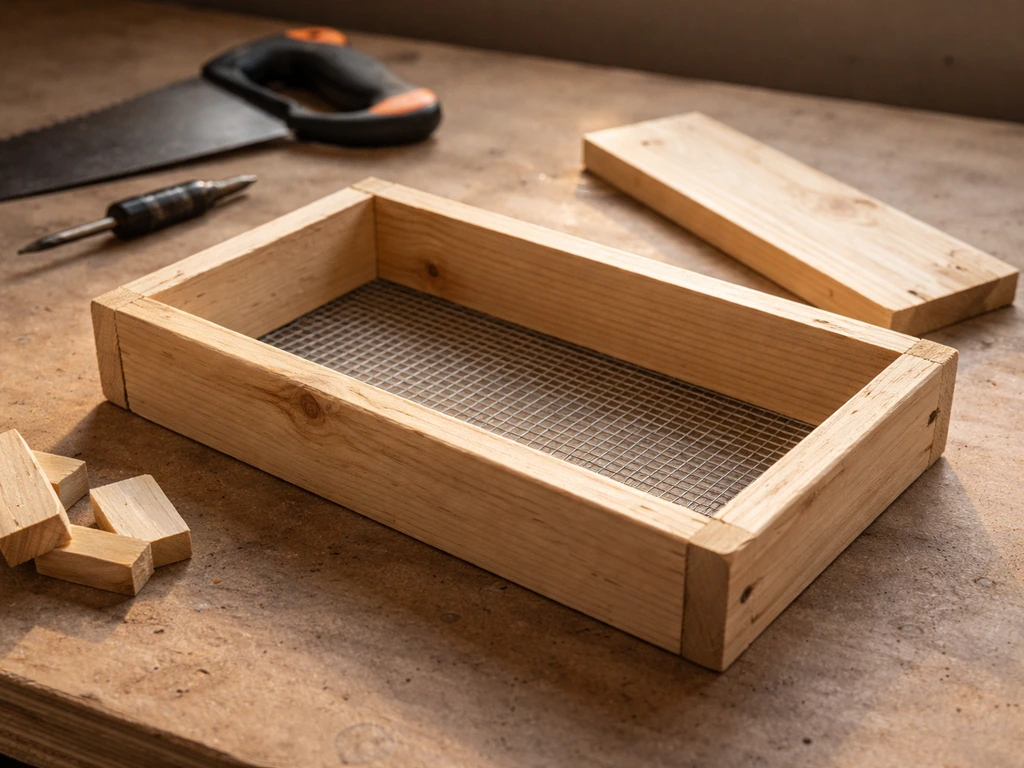
This takes about 30 minutes and costs next to nothing if you have scrap wood. The finished feeder is a shallow wooden tray with a screen or drainage-hole bottom that lets rain pass through so seed doesn't sit in puddles and rot.
- Cut your wood into one 10-inch by 12-inch base piece and four 2-inch tall side strips (two at 10 inches and two at 12 inches). A hardware store will cut this for you if you don't have a saw.
- Sand all edges smooth, especially the top edges of the side strips where birds will perch.
- Attach the four sides to the base using wood screws or exterior glue plus corner brackets. The sides keep seed from blowing or rolling off.
- Drill at least 6 drainage holes (1/4-inch bit) evenly across the base. Alternatively, cut out the center of the base and staple a piece of 1/4-inch hardware cloth wire screen across the opening for even better drainage — this is the better option and worth the extra 10 minutes.
- Drill one hole in each corner of the base, thread wire or paracord through each, gather the four strands, and tie them together 8 to 10 inches above the tray to create a hanging point. Or screw two eye screws into opposite sides and hang it level with an S-hook.
- If you want basic weather protection, screw or nail a simple plywood roof piece (roughly 12 by 14 inches) above the tray using two short vertical dowels or scrap wood legs at each corner, leaving the sides fully open.
Build 2: Basic wooden hopper feeder
A hopper feeder is basically a seed reservoir with walls and a roof. Seed fills a central chamber and gravity feeds it down to a small trough at the bottom where birds eat. It holds more seed, stays drier, and looks more polished. All About Birds explains that hopper feeders have a roof designed to help keep seed dry and fresh hopper feeders are designed to provide a “roof” to help keep seed dry and fresh. Budget about 45 to 60 minutes.
- Cut two side panels (5 inches wide by 10 inches tall), two end panels (4 inches wide by 10 inches tall), one base platform (6 by 14 inches with drainage holes drilled every 2 inches), and two roof pieces (6 inches by 9 inches, angled at the top ridge or just overlapping).
- Assemble the four side and end panels into a box using wood screws. Leave the bottom open — this is where seed will flow out.
- Attach the base platform to the bottom of the box, but leave a 1/2-inch to 3/4-inch gap between the bottom of the box walls and the platform surface. This gap is how seed flows out for birds to reach it.
- Sand all interior and exterior surfaces smooth. Rough spots trap moisture and make cleaning harder.
- Attach the two roof panels at the top at an angle so they form a ridge (like an inverted V). This sheds rain away from the seed chamber. Secure with screws and a bead of exterior wood glue along the seam.
- Drill a hanging hole through the roof ridge, reinforce with a small washer, and thread wire or chain through for hanging.
Build 3: Plastic bottle tube feeder (15-minute budget option)
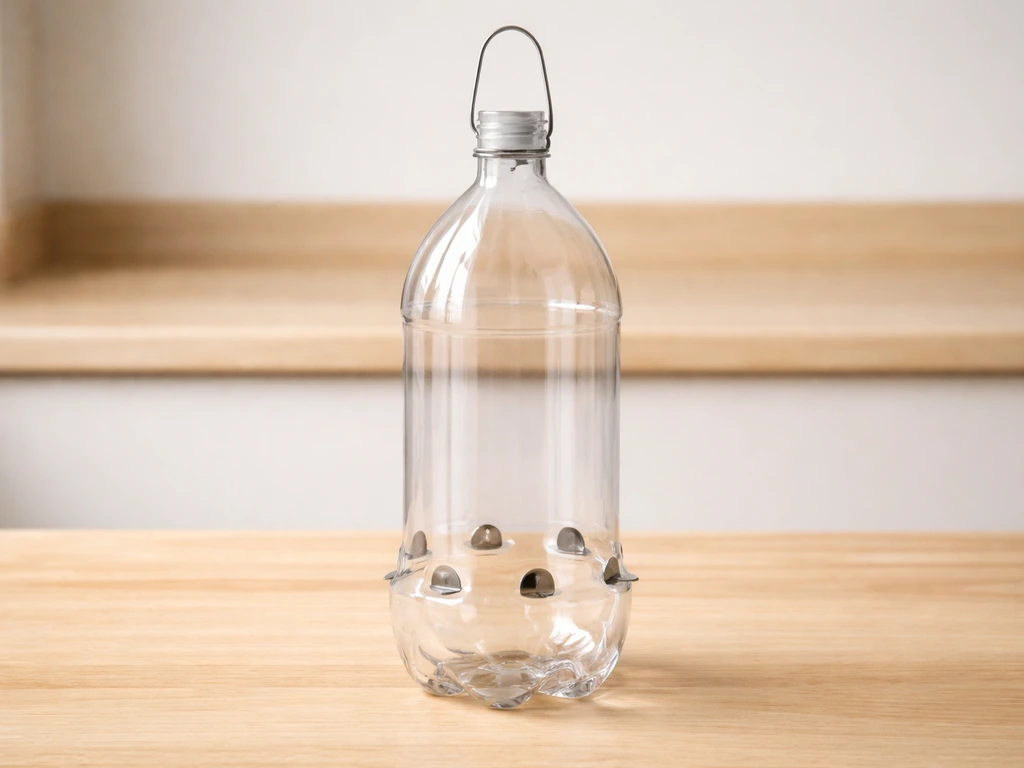
This is the fastest build and costs almost nothing. Use a clean 2-liter bottle or a large plastic juice bottle.
- Rinse the bottle thoroughly and let it dry completely.
- Use a utility knife to cut 4 to 6 small feeding ports around the lower half of the bottle, each about 3/8 of an inch wide and 1/2 inch tall. This size works for sunflower seeds without letting them all pour out at once.
- Just below each port, poke a hole through the bottle with a skewer or small drill bit. Push a wooden dowel (1/4 inch diameter, cut to about 6 inches) through the bottle so it sticks out 3 inches on each side as a perch for birds.
- Drill or poke 4 small drainage holes in the base of the bottle.
- Fill the bottle with black-oil sunflower seeds, screw the cap back on, and hang it upside down from the cap using a wire loop or S-hook threaded through a hole in the cap.
- The cap end becomes the hanging point (now at the top), and the bottle base (with drainage holes) sits at the bottom.
Filling, placing, and hanging it so it actually works
Filling is simple: use black-oil sunflower seeds as your primary seed. They have thinner shells than striped sunflower seeds, which means smaller birds like chickadees and nuthatches can crack them easily. The higher fat content also makes them especially valuable in colder months. Striped sunflower seeds attract larger birds like grosbeaks and bigger woodpeckers, but they exclude a lot of the smaller species you probably want. Fill your feeder about 3/4 full, not to the brim, so there's room for seeds to shift and flow without jamming.
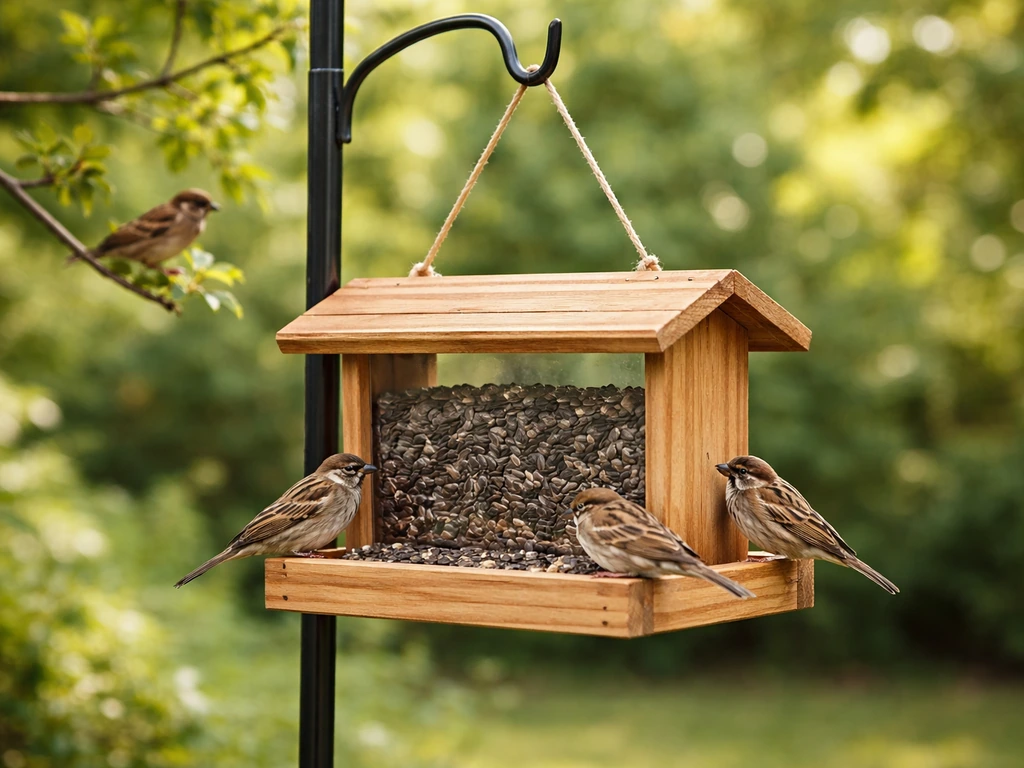
For placement, hang the feeder at least 5 feet off the ground on a smooth metal pole rather than directly from a tree branch. A tree gives squirrels too many jump-off points. Position the feeder at least 10 feet away from the nearest tree trunk, fence, or structure that a squirrel could use as a launch pad. That spacing alone stops most casual squirrel attempts. Place the feeder in a spot with some nearby shrubs or trees within 10 to 15 feet so birds have a quick escape route if a hawk shows up, but make sure the feeder itself is in the open where you can see it and where cats can't hide underneath.
On height and safety: hanging too low (under 3 feet) puts ground-feeding birds at real risk from cats. Hanging too high (over 7 feet) makes it hard to refill and clean. Five to six feet is the sweet spot for most setups. If you're attaching to a deck railing or fence post, use a shepherd's hook extension to get it out away from the structure.
How to use a squirrel baffle (and why you need one)
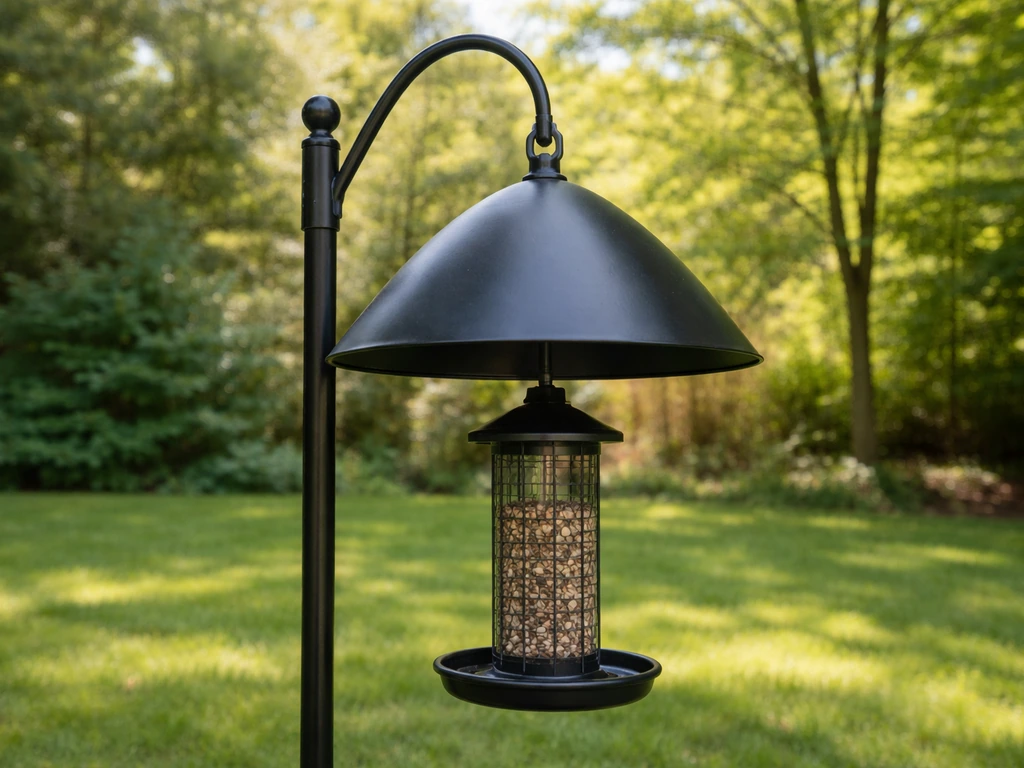
No feeder setup is completely squirrel-proof, but you can get remarkably close. The most effective approach is [mounting a dome-shaped or cone-shaped squirrel baffle on the pole, below the feeder](https://media. audubon. org/audubonguidetobirdfeeding.
pdf). The baffle is a bowl or umbrella-shaped barrier that squirrels can't grip or climb around. Mount it so the top of the baffle is at least 4 feet off the ground (so squirrels can't simply jump over it from the ground) and so there's at least 18 inches of clear pole between the baffle and the feeder bottom. Combined with the 10-foot horizontal clearance from trees and fences, this setup stops the vast majority of squirrel raids.
Baffles cost around $15 to $25 at any hardware or garden store and are genuinely worth it.
Birds that will show up for sunflower seeds
Sunflower seeds, especially black-oil, attract a broader mix of birds than almost any other seed type. Here's what you can realistically expect to see once your feeder is established, usually within the first 1 to 3 days:
- Northern Cardinals (one of the most consistent visitors, especially in the morning and evening)
- Black-capped and Carolina Chickadees (quick, frequent visitors that grab a seed and fly off to eat it elsewhere)
- Tufted Titmice (similar behavior to chickadees, arrive in small groups)
- White-breasted and Red-breasted Nuthatches (known for walking down the feeder headfirst)
- Downy and Hairy Woodpeckers (they'll work a tray or hopper feeder as well as a suet feeder)
- House Finches and Purple Finches (especially if you're using shelled sunflower hearts or chips)
- Mourning Doves (they prefer fallen seed on the ground beneath the feeder)
- Dark-eyed Juncos (ground feeders that benefit from spillage, especially in winter)
- Blue Jays (larger birds that favor striped sunflower; they'll visit black-oil too but tend to dominate the feeder briefly)
If you specifically want to attract finches, a tube feeder with smaller ports and nyjer (thistle) seed works better than sunflower alone. And if you're interested in attracting birds with high-fat feeds beyond seeds, a lard-based feeder is another option worth exploring for winter feeding. If you want to switch things up for winter feeding, learn how to make a lard bird feeder next lard-based feeder. But for raw species diversity at one feeder, nothing beats a sunflower setup.
Keeping it clean, fresh, and pest-free
This is the part most people underestimate, and it's genuinely important. A dirty feeder spreads disease between birds. Mold in wet seed can make birds sick. And once squirrels figure out your setup, they'll be relentless. Here's how to manage all three.
Cleaning schedule
Plan to clean your feeder every two weeks under normal conditions. During wet weather, heavy use periods, or hot summer months, bump that up to once a week. If you ever see sick birds at your feeder or hear about a local disease outbreak, clean it immediately.
The process is straightforward: empty any remaining seed, rinse the feeder with warm soapy water and scrub it with a bottle brush to get into corners and ports, then soak it for 10 minutes in a solution of 1 part bleach to 9 parts water. Rinse thoroughly after the soak (and then rinse again), and let it air dry completely before refilling.
That last step matters: a feeder that's even slightly damp when you fill it will grow mold within a day or two, especially in warm weather.
Dealing with moldy or clumped seed
If you open your feeder and the seed is clumped together, smells musty, or shows any visible mold, throw it all out. Don't try to pick out the bad parts, mold spreads through seed quickly, and the whole batch is compromised. This happens most often after rain gets into a feeder with poor drainage, or when you overfill and the seed at the bottom can't move or breathe. The fix is better drainage (that screen bottom on a tray feeder earns its keep here), smaller fill amounts in wet seasons, and checking seed freshness every few days when it's humid.
Squirrels: what works and what doesn't
The baffle-on-a-pole system described above is genuinely the most effective option. Feeders hung from tree branches with no baffle are essentially a squirrel buffet. Feeders with "squirrel-proof" cages can work but aren't foolproof, and most of the spinning or weight-triggered mechanisms either fail or just make squirrels more determined. The pole-plus-baffle-plus-10-foot-clearance combination is the one that consistently works in practice. Some people add cayenne pepper to their seed mix (birds can't taste capsaicin, mammals can), and while it does deter squirrels, it needs to be reapplied after every rain and is a bit of an ongoing hassle. Start with the physical setup first.
Other pests worth knowing about
- Raccoons: they'll tip over or dismantle a tray feeder at night. Bringing the feeder inside at dusk solves this if it becomes a problem.
- Starlings and House Sparrows: they flock to open tray feeders in large groups and crowd out native birds. A tube feeder with smaller perches physically limits their access.
- Mice and rats: attracted to seed spillage on the ground, not usually to the feeder itself. Sweep up hulls and spilled seed regularly, or use a seed tray catcher beneath the feeder.
- Deer: they'll bend or knock over shepherd's hooks. A sturdy metal pole set into the ground (not just a hook on a thin stake) handles this.
Your next steps after the build
Once your feeder is built, filled, and hung, give it two to three days before worrying that nothing is showing up. If you want to switch things up from sunflower seeds, you can also learn how to make a mealworm bird feeder for insect-loving species. Birds are cautious about new objects in their territory. You can speed up the discovery process by scattering a small handful of seeds on the ground directly below the feeder, which catches the attention of ground-feeding birds like doves and juncos, who will alert other species with their activity. Once a few birds find it, others follow quickly.
From there, the routine is simple: top off the feeder every two to three days (or whenever it drops below half), do a quick visual check for wet or clumped seed each time you refill, and do a full bleach clean every two weeks. Keep a small brush near your back door so the cleaning step stays easy. That's genuinely all it takes to run a successful sunflower seed feeder year-round. If you want a more decorative option, you can adapt the same hopper or tube principles to a bundt pan bird feeder design as well.
FAQ
How long should I wait for birds to show up after I hang the feeder? Should I do anything to speed it up?
If birds keep ignoring a brand-new feeder, wait a full 3 days before changing anything, then reduce competition for attention. Scatter a small handful of black-oil sunflower seeds on the ground directly under the feeder (about a 1 to 2 foot circle). Ground feeders often discover the spot first, and their activity helps other species “find” the feeder quickly.
Can I fill the sunflower bird feeder completely, or should I leave some headspace?
Yes, but match the plan to your feeder type. Tray feeders should use a shallow fill and a drainage-friendly bottom so seeds do not sit wet. Bottle and tube styles should stay less than about 3/4 full, since shifting seed can block ports. Avoid overfilling on any style because seed at the bottom becomes the first to mold after rain.
What should I do if the seed gets wet, clumps up, or smells musty?
If seeds clump or the feeder smells musty, stop using it immediately and treat it as contaminated, even if only part of the seed looks bad. Empty the feeder, clean and disinfect it, then restart with fresh black-oil sunflower seeds (old seed often retains moisture or mold spores). Also check for rain exposure, poor drainage, or leaks around the port openings.
Do I need to worry about hulls and dust when using sunflower seeds?
Sunflower seeds can be “too fresh” in the sense that dust and broken seed can accumulate and attract unwanted pests. On setup day, discard the first handful if it contains lots of hull dust, and during refills scrape out any seed husk buildup from corners and around the drainage holes or screen bottom. This improves airflow and reduces the chance of mold pockets.
How can I avoid hurting birds with a homemade feeder opening or screen gaps?
To prevent birds from getting stuck, check the port openings and any screen gaps for size and sharp edges. Drainage holes should be wide enough for water to exit but not so wide that a bird’s toes can catch. If you are using a bottle or tray with a cut opening, sand rough edges and ensure all surfaces are smooth before hanging.
My squirrel baffle isn’t working, what are the most common reasons?
If squirrels are still getting to the feeder, confirm the spacing, then upgrade the “access routes.” Make sure the baffle is properly positioned with clear pole space (about 18 inches) between the baffle and the feeder bottom, and keep the feeder at least 10 feet from any launch point like a tree trunk, fence corner, or shrubs. If the pole is textured or the baffle is climbable, switch to a smoother metal pole or a properly sized baffle.
Should I change the seed type or feeding schedule in summer versus winter?
Yes. Even if you only feed seeds, switch seed types seasonally to reduce waste and improve feeding. In very cold weather, keep using black-oil sunflower seeds (higher fat). In warmer, humid periods, use smaller fill amounts more often and inspect more frequently for damp clumping.
If I have to clean the feeder, how should I handle the old seed and refill process so it doesn’t happen again?
Plan for a quick “hot swap” when you notice problems. Keep a second bag of fresh seed and, if you see wet or moldy conditions, empty the feeder, clean it, then refill with fresh seed once fully dry. This avoids repeatedly cycling the same contaminated seed back into a damp feeder.