The safest, most stable way to hang a bird feeder comes down to three decisions: what you're hanging it from, what hardware you're using, and how high off the ground it ends up. Get those three right and birds will find it within days. Get them wrong and you'll be dealing with a feeder that spins in the wind, attracts squirrels, or ends up in the yard after the first storm. This guide walks you through every scenario, from a simple tube feeder on a shepherd's hook to a heavy platform feeder mounted on a fence post.
How to Hang Bird Feeders: Safe Setup on Fence & More
Marcus Brennan
23 Mar 2026
Choosing the right hanging setup for your feeder type
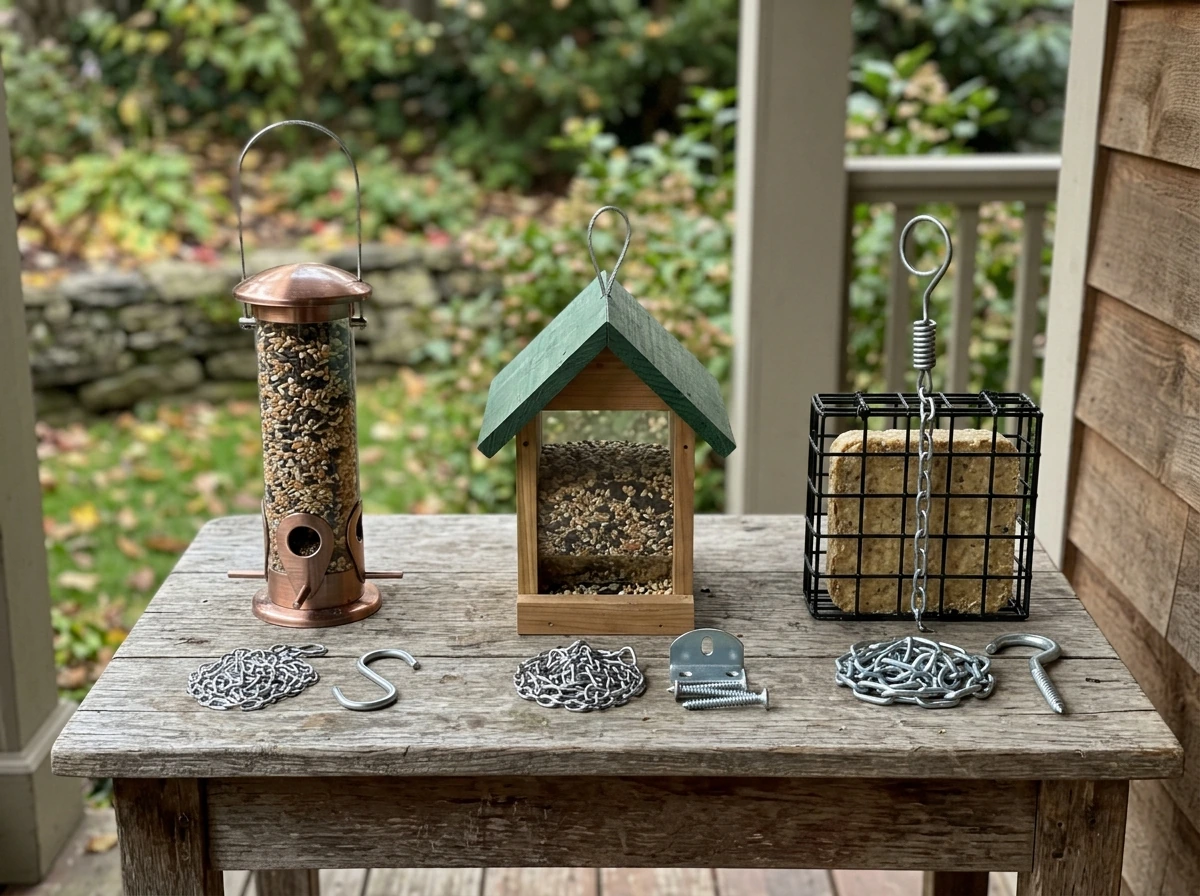
Before you grab a hook or drill a hole, match your hanging method to the feeder you actually have. A lightweight tube or suet feeder behaves very differently from a large platform feeder once wind and load are factored in.
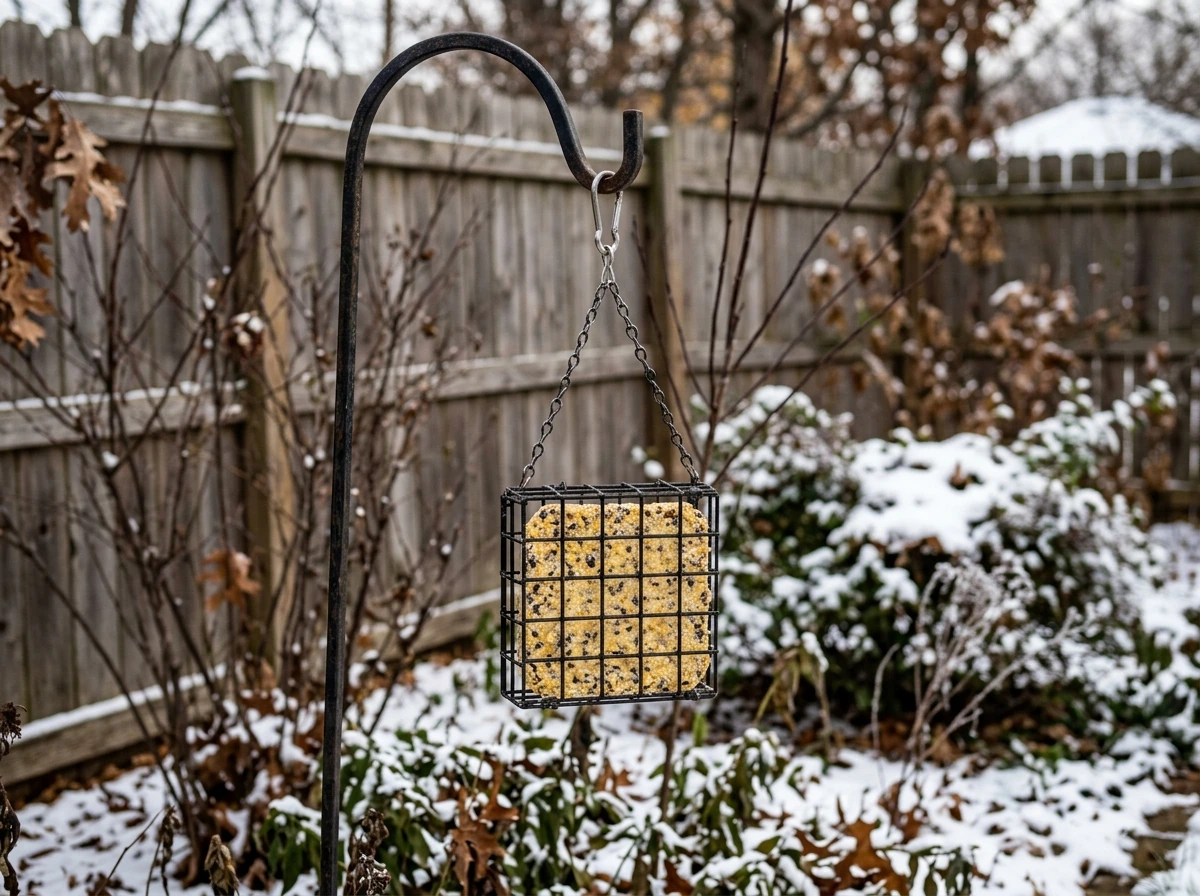
Tube feeders and small hopper feeders are the easiest to hang. They typically weigh well under two pounds empty, and even fully loaded with seed they rarely exceed four to five pounds. A standard S-hook and chain handle these without any drama. Suet feeders are even lighter, many coming in around a quarter pound empty, and with a standard 2 to 2.75 pound suet cake loaded they're still manageable on a basic vinyl-coated steel cable or a short length of chain. how to make pinecone bird feeder. how to make a hanging bird feeder. how to hang pine cone bird feeder. how to hang a mason jar bird feeder
Platform feeders are a different story. A large hanging platform feeder can weigh 6 pounds empty, and once you factor in wet seed after rain plus the birds landing on it, you're putting real stress on your hardware and mounting point. For these, you need a beefier hook, a sturdier arm or bracket, and a mounting point that can handle dynamic load, not just static weight. If you're building your own, the guide on how to make a hanging bird feeder covers construction choices that affect hanging stability from the start.
The core rule: lightweight feeders (under 5 lb loaded) can go almost anywhere with standard hardware. Heavy feeders (5 lb and up, loaded) need a dedicated pole, a lag-screwed bracket, or a structural branch, not a thin wire looped over a twig.
What to hang a bird feeder from
You've got more options than you might think, and each has trade-offs.
Trees
A mature tree with a strong horizontal branch is the classic option, and it works well if you use it correctly. The problem most beginners run into: they hang the feeder too close to the trunk or on a branch that squirrels can reach from the main limb. Wild Birds Unlimited recommends keeping hanging feeders at least 10 feet away from objects (fences, trees, rooftops) that squirrels can use as a launch point. That's harder to achieve on a tree than on a freestanding pole, which is why a dome squirrel baffle above the feeder is almost mandatory in a tree setup. If the branch can be accessed from above or from the trunk, squirrels will exploit it.
Freestanding poles and shepherd's hooks
A metal shepherd's hook or a dedicated feeder pole pushed firmly into the ground is the most reliable all-around option for most yards. Wild Birds Unlimited's pole systems are designed to position feeders at about 4 to 5 feet above ground, which is within easy viewing range and high enough to discourage most cats. Poles also let you add a squirrel baffle below the feeder, which is far more effective than trying to baffle a tree-hung setup. If the soil is loose or you're dealing with high winds, drive the pole deeper (at least 12 to 18 inches) or use a ground anchor sleeve.
Fences
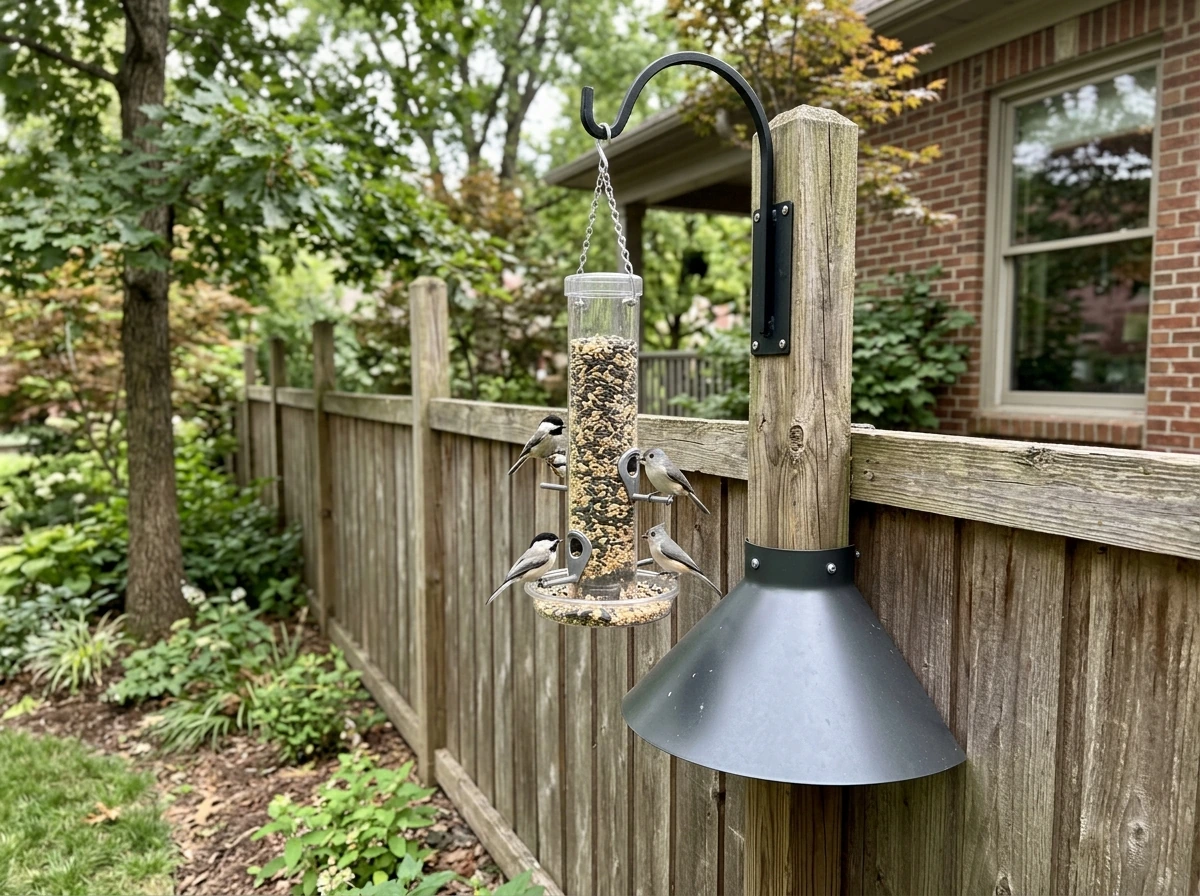
Fences are convenient but come with stability challenges. A feeder hanging directly from a fence rail will swing, spin, and spill seed every time there's a breeze. The better approach is to mount a bracket or arm to the fence post rather than the rail, then hang the feeder from that arm. Posts are structural; rails flex. More on the specifics of fence hanging in the dedicated section below.
Eaves, overhangs, and gutters
You can hang a lightweight feeder from a screw hook drilled into a soffit or wooden overhang, and many people do. It keeps the feeder dry and visible from a window. The catch is placement relative to your windows. Audubon and the US Fish and Wildlife Service both recommend placing feeders either within 3 feet of a window or more than 30 feet away. The logic: within 3 feet, birds can't build up enough speed to cause a serious collision if they startle; beyond 30 feet, they have room to redirect. The dangerous zone is roughly 3 to 30 feet from glass, where birds can hit at full speed. If you're hanging from an overhang right next to a window, make sure you're within that 3-foot safe zone, not 6 or 8 feet away.
How to hang a bird feeder: the general method
This process works for most standard tube, hopper, or suet feeders hung from a pole, hook, or branch. Adjust based on your specific mounting point, if you're specifically wondering how to hang a suet bird feeder, follow the suet-style structural guidance here.
- Choose your mounting point first. Confirm it's structural and can handle the loaded weight of your feeder. Wiggle-test a branch; make sure a pole is driven at least 12 inches into the ground.
- Set your height target. Aim for 4 to 5 feet above ground as a baseline. This puts the feeder at easy bird-access height and within your sightline from a seated position indoors.
- Check window proximity. Measure the distance from the planned feeder location to the nearest window. Stay within 3 feet or push past 30 feet to avoid the collision risk zone.
- Attach your primary hook or bracket to the mounting point. For a tree branch, use a J-hook or a purpose-made branch hanger with a rubber-coated contact point to protect the bark. For a pole, slide or screw the hook into the top fitting.
- Connect your chain or wire to the hook, then attach the feeder's hanging loop to the bottom of the chain. Use a secure S-hook or a locking snap hook. Open S-hooks are convenient but can vibrate loose over time; squeeze the ends slightly with pliers to tighten the gap.
- Add a squirrel baffle if needed. For a pole setup, position a cone or cylinder baffle at least 4 to 5 feet off the ground on the pole itself, below the feeder. For a hanging chain from a tree or overhang, add a dome baffle directly above the feeder on the chain.
- Fill the feeder and check the hang. Give the feeder a gentle push to confirm it swings freely without catching on anything and returns to a level position.
- Step back and observe for the first 48 hours. Watch for excessive swinging, tilting (which causes seed to dump), or signs that squirrels have already figured out a route.
Hanging a bird feeder on a fence
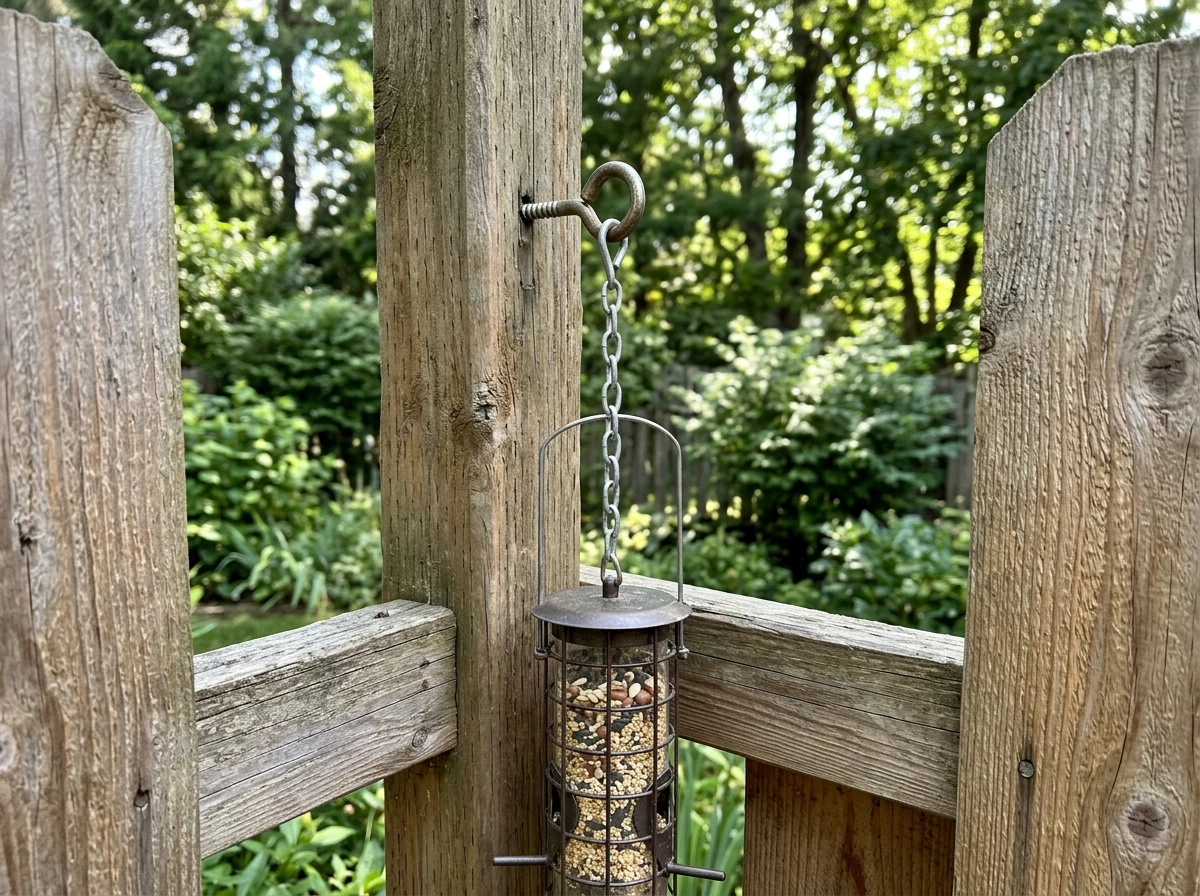
A fence is one of the most requested mounting spots, usually because it's the most accessible surface in a yard. It works fine with the right approach, but there are a few real problems to solve upfront: fence rails flex, wind amplifies movement, and a fence puts your feeder at squirrel highway level.
Mount to the post, not the rail
Fence posts are the load-bearing members. Rails (the horizontal boards) are just for the fence panels and aren't designed to carry a swinging, dynamic load. Use a wood screw hook (at least 2.5 inches long) or a lag bolt bracket screwed directly into the fence post. If you have a metal fence, clamp-style shepherd's hook adapters that bolt around a metal post work well and don't require drilling.
Add an arm or extension bracket
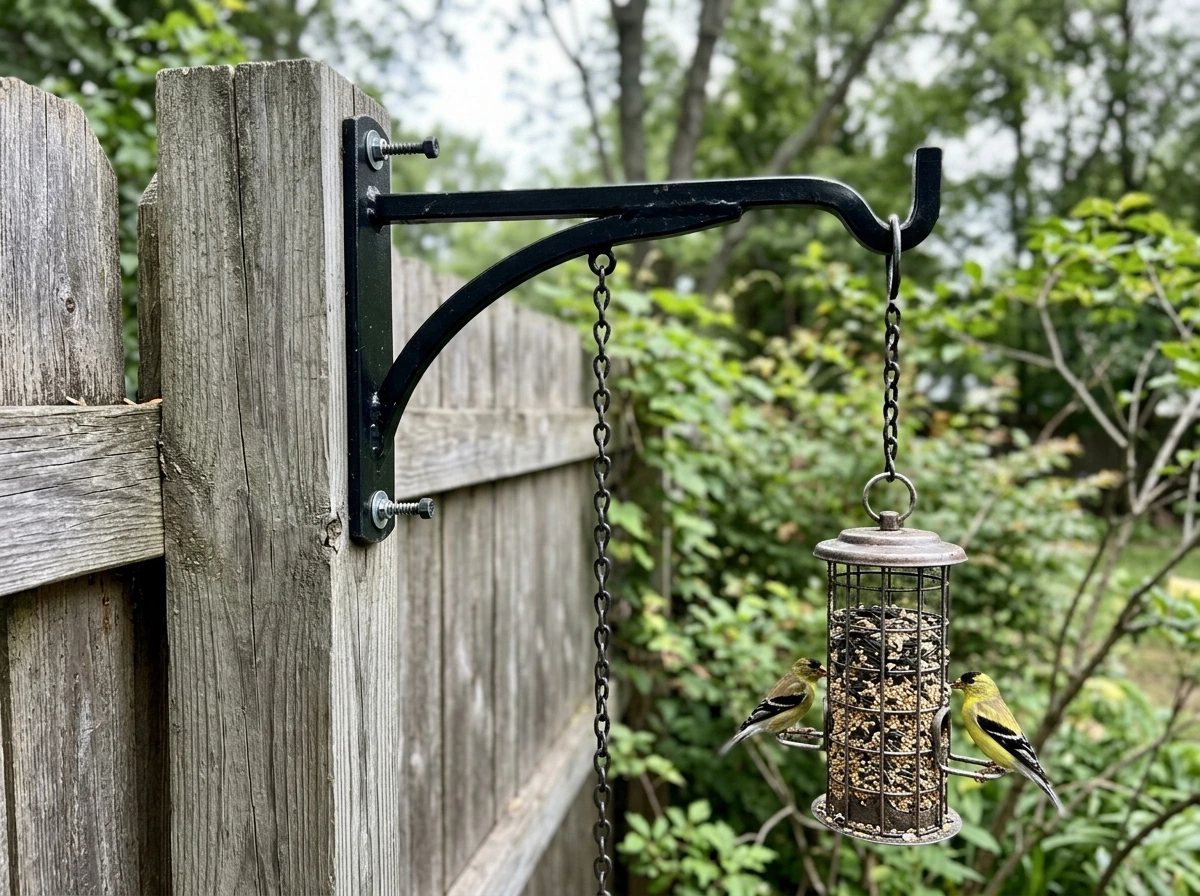
Hanging a feeder directly against a fence face puts it too close to the structure and gives squirrels an easy surface to launch from. A 6 to 12-inch arm bracket screwed into the post extends the feeder out from the fence, reduces squirrel access from the fence top, and gives birds a clear approach path. These are available at most hardware stores for a few dollars, or you can DIY one from a bent piece of galvanized conduit.
Reduce swinging and instability
Wind hits fence-hung feeders hard because fences are often at the perimeter of a yard with less wind break than the interior. Shorten the hanging chain to reduce the swing arc. A shorter hang means less momentum when wind hits. For platform feeders on a fence, consider screwing a mounting bracket directly to the post rather than hanging the feeder on a chain at all. A rigid mount on a post is almost completely wind-stable.
Hanging heavy feeders and multiple feeders safely
Heavy feeders and multi-feeder setups are where hardware choices start to matter more than most people expect. A Perky-Pet rust-resistant metal hook sold at Home Depot, for example, is rated to 25 pounds, which comfortably handles even a loaded large platform feeder. A Perky-Pet powder-coated hanging chain is rated to 16 pounds. Know your hardware ratings before you hang anything that pushes the scale.
Single heavy feeders
For any feeder you expect to load past 5 pounds, use a dedicated feeder pole with a rated arm rather than a repurposed hook or a branch of uncertain strength. Make sure every link in the connection chain (bracket to pole, chain to bracket, feeder to chain) is rated at or above your expected loaded weight. When in doubt, a heavier-duty hardware store S-hook or a locking carabiner-style snap hook is more reliable than the thin wire loop that often comes packaged with a feeder.
Multiple feeders on one pole or arm
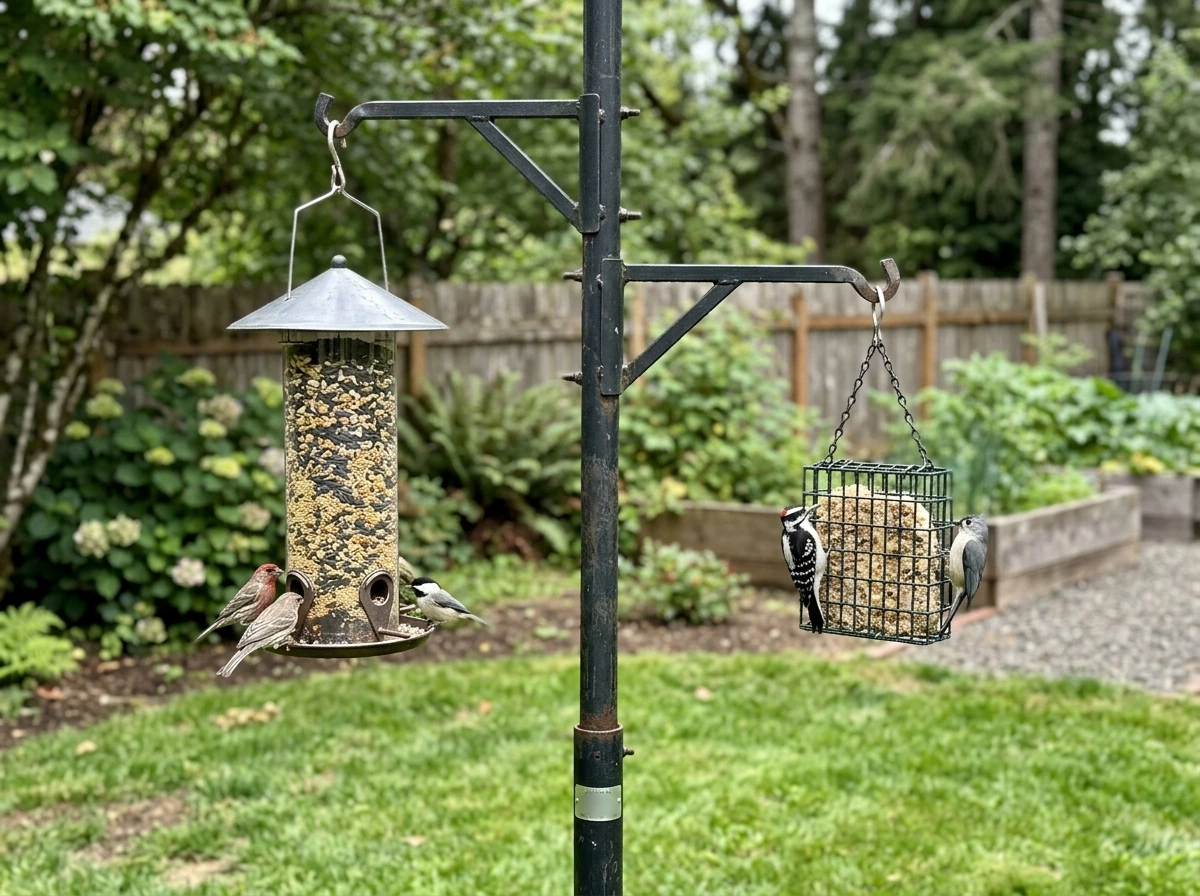
Multi-armed feeder poles are popular but easy to overload. Add up the loaded weights of every feeder you plan to hang and compare that to the pole's stated capacity. Space multiple feeders at least 18 to 24 inches apart horizontally so birds at one feeder don't interfere with birds at another, and so the feeders don't collide in wind. Wild Birds Unlimited notes that using multiple feeder heights also attracts a broader variety of species, so staggering your arms at different heights on the same pole is a smart strategy, not just a visual choice.
For two or more feeders hung from the same tree branch or overhead structure, make sure you're distributing load across different attachment points rather than daisy-chaining everything onto a single hook. A single point carrying three loaded feeders is a single point of failure.
Choosing the best hardware and materials
The hardware you use determines how long the setup lasts and how safe it is when a feeder is loaded and swinging in a storm. Here's how the main options compare:
| Hardware | Best For | Load Capacity | Weather Resistance | Notes |
|---|---|---|---|---|
| Powder-coated hanging chain (e.g., Perky-Pet 33-inch) | Most standard feeders | Up to 16 lb rated | Good (rust-resistant coating) | Affordable, widely available; squeeze S-hooks tight |
| Rust-resistant metal hook (e.g., Perky-Pet) | Shepherd's hook tip or bracket end | Up to 25 lb rated | Good | Use for heavier feeders; check for wobble at base |
| Galvanized steel wire | Lightweight tube/suet feeders | Varies by gauge; 14-gauge handles 5+ lb | Excellent long-term | Loop ends securely; avoid thin craft wire |
| Vinyl-coated steel cable | Suet feeders, small to mid feeders | Moderate (check spec) | Very good | Protects bark if looped over a branch |
| Screw-in eye hook (wood) | Soffit, wooden post, or beam | Depends on substrate; 2.5-inch lag = strong | Fair (paint or seal the threads) | Most reliable fixed mount for wooden structures |
| Plastic zip ties | Temporary only | Low | Poor (UV degradation) | Fine for trial placement; replace with metal hardware |
| Open S-hook | Light to medium feeders | Typically 10–20 lb | Fair (rust over time) | Squeeze the ends with pliers to prevent unhooking |
| Snap hook / locking carabiner | Heavy feeders, permanent installs | High (check rating) | Good with stainless or coated | Best option for heavy or high-value feeders |
The recommendation: for anything under 10 pounds loaded, a quality powder-coated chain paired with a rated hook gets the job done cleanly. For heavier feeders or permanent installations, upgrade to a locking snap hook and a lag-screwed eye bolt in a structural member. Skip zip ties for anything permanent; UV exposure degrades them within a single season and they'll fail without warning.
If you're hanging with rope, use braided polyester or nylon rated for outdoor use, not cotton clothesline, which rots fast. If you're hanging with rope, use braided polyester or nylon rated for outdoor use, not cotton clothesline, which rots fast. For a more detailed look at rope-based hanging, the guide on how to hang a bird feeder with rope covers knot choices and longevity. And if you want a hands-free, adjustable setup, the pulley guide on how to hang a bird feeder with a pulley is worth reading for high-branch or hard-to-reach spots.
Smart bird feeders: what's different about hanging them
Smart bird feeders like the Birdfy series add a camera and app connectivity to a standard feeder body, and that changes a few things about placement and setup beyond what a regular feeder requires.
First, the physical setup. Birdfy recommends mounting on a pole at least 1.5 meters (about 5 feet) above ground, which lines up well with standard feeder height guidance. Add a squirrel baffle below on the pole because smart feeders are more expensive to replace than a basic tube feeder. The camera lens needs a clear, unobstructed field of view, so avoid hanging positions where branches, fence rails, or hanging chains will frequently swing in front of the camera.
Second, Wi-Fi range matters more than it does with a regular feeder. The feeder needs to connect to your home network, so the hanging location has to be within reliable Wi-Fi range. Most smart feeders require you to install the app and complete the pairing process before the feeder is fully functional. That means choosing a spot close enough to your router, or planning for a Wi-Fi extender, before you finalize where you hang it. Testing connection strength at the planned location with your phone before committing to a mounting point saves a lot of frustration.
Third, cable management. Some smart feeders have a power cable option as well as battery power. If you're using a power cable, plan the hanging location with a nearby outlet or weatherproof extension cord route in mind. Don't let a power cable hang loosely where birds can perch on it or squirrels can chew it.
For suet-specific smart setups, the same physical principles apply. The guide on how to hang a suet bird feeder covers the structural specifics for that feeder style if you're pairing a camera with a cage-style suet holder.
Practical tips, troubleshooting, and keeping things working
The feeder keeps swinging or spinning
Excessive swinging usually means the hanging chain is too long or the mounting point is too flexible. Shorten the chain by linking it higher on the hook, or switch to a rigid bracket mount instead of a hanging chain for platform-style feeders. A feeder that spins constantly in wind will spill seed and deter birds that prefer a stable perch.
Birds aren't coming after a week
Give it 10 to 14 days minimum. Birds are cautious about new food sources. Make sure the feeder is visible from above (birds scout from height before descending) and isn't completely blocked by dense foliage. Placing it near existing shrubs or within view of a perching branch helps, since birds like to have a nearby landing spot to assess the area before committing to the feeder.
Squirrels are still getting to it
If you have a baffle and squirrels are still reaching the feeder, measure the distance to the nearest jump-off point. Wild Birds Unlimited's guidance calls for at least 10 feet of horizontal clearance from any surface a squirrel can launch from. Most yards require combining location (open space away from fences and trees) with a properly positioned baffle rather than relying on either alone.
Hardware is rusting or the chain is weakening
Inspect all hardware at least twice a year, ideally at the start of spring and fall. Open S-hooks that have started to rust can fail under load. Look for cracks or corrosion at connection points, especially where a hook loops through a chain link. Replace anything that looks questionable before the feeder fails and drops, which can damage the feeder and injure birds on or around it.
The feeder is tilting and spilling seed
A tilting feeder usually means the hanging loop or wire on the feeder itself is off-center, or the chain is attached asymmetrically. Re-center the attachment point at the top of the feeder. If the feeder doesn't have a centered hang point by design (some platform feeders have offset rings), add a small equalizing ring or re-route the chain so it distributes weight evenly.
Quick maintenance checklist
- Check all hooks and chain links for rust or deformation monthly
- Re-tighten screw-in hooks at the start of each season (wood expands and contracts with temperature changes)
- Clean the feeder with a mild bleach solution every 2 to 4 weeks to prevent mold in seed ports
- Check the pole or post base for loosening after heavy rain or frost heave
- Confirm the squirrel baffle is still positioned correctly and hasn't slid down the pole
- Test the swing and level of the feeder after any major wind event
- If using rope, check for fraying at knots and at any point of contact with a rough surface
Once everything is set, hang the feeder, fill it, and walk away. Resist the urge to check constantly in the first few days. Birds need to discover it on their own schedule. Within two weeks, if the location is right and the setup is stable, you'll have regulars. From there, maintenance is the whole job, and it's a light one if you built the setup correctly the first time.
FAQ
Can I hang a bird feeder using a cable or wire instead of chain?
Yes, but only if you keep it structural and stable. Use a bracket or arm that fastens to a load-bearing member (a fence post, a solid tree trunk with a rated strap, or a dedicated feeder pole), and avoid wrapping wire around flexible elements like fence rails or small branches. If the cable or wire is the only “support,” it must be rated for the full loaded weight plus wind movement, and the attachment points should be secured so the feeder cannot walk sideways over time.
What should I do if my feeder keeps tilting or spinning?
If a feeder keeps tilting, first check that the feeder’s own hanging ring or loop is centered, then verify that the chain or cable connects symmetrically at the top. For platform feeders, switch from a hanging-chain setup to a rigid arm/bracket mount when possible, since wind-induced torque exaggerates off-center hangs.
How do I stop a feeder from swinging too much in wind?
Start by measuring the swing and checking where it contacts seed. Shorten the hanging chain and remove any excess slack. Also inspect the mounting point for flex (rail, thin branch, or loose screws), because movement in the support amplifies the feeder swing. For heavy feeders, move to a dedicated pole or a bracket-mounted post connection rather than relying on a hanging length.
Is it okay to use zip ties to secure the feeder?
You generally should not. Zip ties degrade quickly in sun and heat exposure, and they fail without much warning under repeated loading and vibration. If you need a temporary hold while you adjust placement, use it briefly, then replace with rated hardware like a powder-coated chain, a proper hook, or a lag-screwed eye bolt.
My yard is small, what’s the best placement when squirrels can still reach it?
Aim for placement that balances bird access with squirrel and safety concerns. If you can’t achieve the recommended clearance from squirrel launch points, add a baffle and also move the feeder so it is not directly reachable from the nearest tree limb or fence top. In tight yards, prioritize a pole setup (with baffle) over a tree branch setup.
How can I safely test the mount before filling the feeder with seed?
Do a quick “load test” before filling. Hang the empty feeder from the final setup and gently apply downward force similar to the expected loaded weight (or simulate by using filled containers), then check for looseness at every connection point. If anything shifts, creaks, or rotates, stop and upgrade the mount or hardware before adding seed.
How often should I inspect and replace the hardware?
For poles and post mounts, clean and inspect after storms or at least twice a year. Look for rust at hooks, cracks at brackets, loosening screws or lag bolts, and corrosion at any link-to-ring connection. Replace parts that show pitting, bending, or reduced diameter, since weakened hardware can fail suddenly.
Can I hang multiple feeders from the same hook or branch?
Yes, and it’s a common setup mistake. Keep feeders spaced so they don’t collide in wind (at least about 18 to 24 inches horizontally), and ensure each attachment point is independently supported. Avoid hanging multiple heavy feeders from a single hook or chain junction, since it becomes a single point of failure.
What extra checks should I do when installing a smart bird feeder?
Smart feeders usually need more than “good visibility,” they need a clear camera view and consistent connectivity. Before final mounting, stand where you plan to install and test Wi-Fi strength with your phone at that exact height and location. If the camera lens view will be blocked by swinging chain links or nearby branches, reposition or shorten the hanging length to reduce occlusion.
How do I apply the window-distance rule if I hang the feeder from a roof overhang?
Use the safe window-zone rule relative to glass, not just the feeder location. If you hang from an overhang, verify the distance from the actual feeder opening to the window, since being “near the window” but outside the correct range changes the risk. If you cannot meet the safer-distance rule, consider using placement that keeps the feeder closer to the window (within the safe zone) or farther away than the risky band.
Next Article
How to Hang a Suet Bird Feeder: Step by Step Guide
Step-by-step how to hang a suet bird feeder, choosing the right method, height, placement, and securing to prevent swing